


Top Software Development Trends Businesses Should Watch in 2026
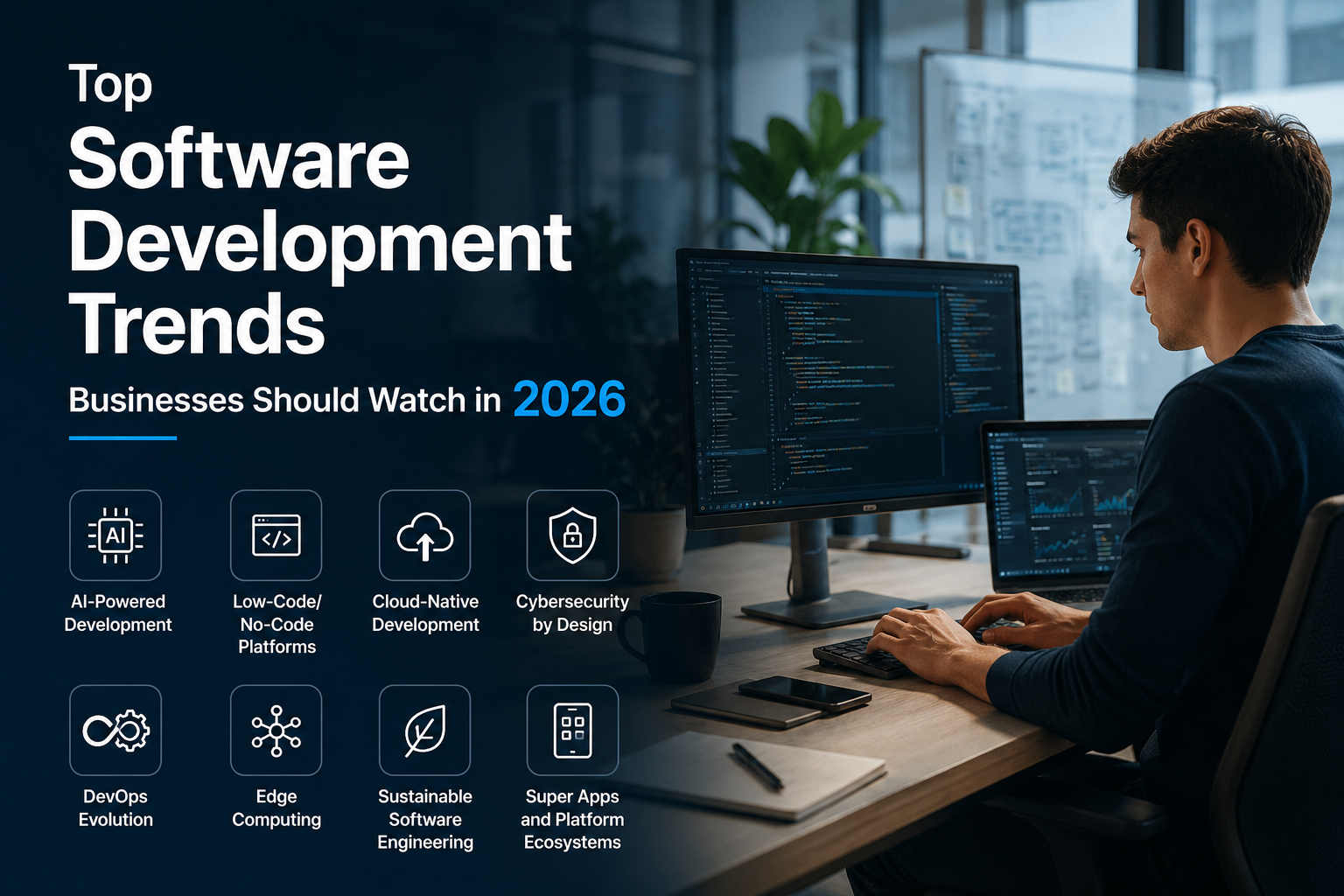
Technology moves fast. And if you are running a business today, you already know that staying ahead of the curve is not just smart, it is necessary. The way companies build their digital products has changed dramatically over the last few years, and 2026 is shaping up to be one of the most defining years in the history of software.
Whether you are a startup trying to launch your first product or an established company looking to modernize your systems, understanding where custom software development is headed gives you a real competitive edge. The businesses that track trends early tend to make better decisions, spend smarter, and build products that actually hold up over time. This article walks you through the trends that actually matter, explained in plain language with practical context, so you can use this as a reference when planning your next move.
Why Businesses Cannot Afford to Ignore Software Trends Anymore
There was a time when software was a back-office concern. Now it is the front door of almost every business. Your customers interact with your brand through apps, portals, dashboards, and digital touchpoints before they ever speak to a human being. That shift has put enormous pressure on the quality and intelligence of the software that businesses rely on.
The companies that fall behind on software trends do not just lose efficiency. They lose customers. A slow checkout experience, a buggy mobile app, or a platform that does not scale during peak traffic can push users straight toward a competitor. According to research from Gartner, digital experience is now the number one differentiator in most industries, ahead of product and price.
So why do businesses need to follow the trends? Because your competitors are. Companies like Amazon, Walmart, and Flipkart constantly invest in evolving their software infrastructure, not because they have endless budgets, but because they understand that their digital stack is their business model. Smaller businesses that adopt the right software solutions development practices early tend to punch far above their weight in their markets.
The good news is you do not need to chase every trend blindly. You just need to understand which ones apply to your business context and build around them strategically. That is exactly what this article helps you do.
1. AI Integration Is Becoming the Default, Not the Exception
A few years ago, adding AI to a software product was considered innovative. Today, it is quickly becoming the baseline expectation. In 2026, the question is no longer whether your software should use artificial intelligence but how deeply it should be embedded into the user experience and the backend operations.
The shift is happening across every industry. In retail, AI powers recommendation engines and dynamic pricing. In healthcare, it supports diagnostic tools and patient routing systems. In finance, it drives fraud detection and credit scoring in real time. What used to require a team of data scientists and months of training now comes prebuilt through APIs from providers like OpenAI, Google DeepMind, and AWS SageMaker.
For businesses investing in custom software development, the implication is clear: you need to design your software architecture with AI integration in mind from day one. That means building data pipelines that feed clean, structured data into your models, creating feedback loops that improve predictions over time, and making sure your development team understands how to work with large language models and machine learning endpoints.
The risk of ignoring this trend is real. Customers now expect smart software. They expect it to predict what they need, adapt to how they behave, and surface the right information at the right time. Software that does not use AI in some meaningful way will start to feel outdated quickly, even if it works perfectly from a technical standpoint.
2. Custom Software Development Is Replacing Generic Off-the-Shelf Tools
For years, businesses bought ready-made software solutions and tried to fit their operations around them. That approach is losing ground fast. In 2026, more businesses are moving toward custom software solutions that are built specifically for how they operate, not how a vendor thinks they should operate.
The reason for this shift is straightforward. Generic tools come with compromises. You get features you do not need, you miss features you do, and you often end up paying subscription fees that grow faster than the value you receive. Worse, when you rely on a third-party platform for something critical, you are at the mercy of their product roadmap and pricing decisions.
Custom software development gives businesses full ownership. You control the features, the data, the integrations, and the roadmap. You can build exactly what your team needs without workarounds or workarounds on top of workarounds. A logistics company in Noida, for example, might need software that manages inventory across warehouses in Delhi, connects with specific courier APIs, and generates GST-compliant invoices automatically. No off-the-shelf product does all of that cleanly. But a custom-built platform can.
The investment conversation has also changed. Building custom is no longer reserved for large enterprises with deep pockets. Modern development frameworks, reusable component libraries, and cloud-native infrastructure have brought down the cost and timeline for custom software significantly. A well-scoped project can often be built and deployed in a matter of months rather than years.
3. Mobile App Development Is Shifting Toward Cross-Platform and Super Apps
Mobile is not a trend anymore. It is the primary interface for most users, especially in markets like India where smartphone penetration continues to climb rapidly. What is trending in 2026 is how mobile apps are being built and what they are expected to do.
Cross-platform mobile app development using frameworks like Flutter and React Native has become the standard approach for most businesses. Instead of building separate codebases for iOS and Android, developers write once and deploy across both platforms with near-native performance. This cuts development time significantly and makes it easier to maintain a single codebase as the product evolves.
The bigger shift, though, is toward the concept of super apps. Instead of offering a narrow, single-purpose app, businesses are building platforms that handle multiple functions within one experience. Think of how PhonePe in India started as a payments app and expanded into insurance, investments, merchant tools, and travel bookings. That model is spreading across verticals.
This matters for businesses in every sector. If you are building or rebuilding a mobile product in 2026, you should think beyond the immediate use case. Design the architecture to support modular expansion so you can add features without rebuilding from scratch. Users are developing app fatigue. They do not want to install five apps to interact with your brand. They want one app that does everything they need.
4. Cloud Cost Optimization Is Now a Board-Level Conversation
Moving to the cloud solved a lot of problems for businesses. It removed the need for physical servers, made scaling easier, and enabled remote teams to collaborate globally. But it also introduced a new problem that many businesses did not anticipate: runaway cloud bills.
Cloud cost optimization has emerged as one of the most critical software development solutions concerns in 2026. According to Flexera's State of the Cloud report, organizations waste an average of 28% of their cloud spend on unused or underused resources. That is a significant number, and it adds up to millions of dollars across the industry annually.
The solution is not to abandon the cloud. It is to build smarter. This means adopting a FinOps mindset, where engineering, finance, and operations teams work together to monitor and manage cloud expenditure in real time. It means using auto-scaling policies that match resource usage to actual demand rather than provisioning for peak at all times. It means choosing the right storage tiers, using reserved instances for predictable workloads, and identifying idle resources before they drain budget.
For development teams, cloud cost optimization also means writing more efficient code. Poorly optimized database queries, unnecessary API calls, and bloated container images all contribute to higher compute costs. Businesses that treat cost efficiency as a development discipline, not just a finance problem, end up with software that is both more reliable and more affordable to operate at scale.
5. Low-Code and No-Code Platforms Are Changing Who Builds Software
One of the more interesting developments in software development in 2026 is that building software is no longer the exclusive domain of developers. Low-code and no-code platforms have matured to the point where non-technical teams can build functional, production-ready applications without writing a single line of code.
Platforms like Bubble, OutSystems, and Microsoft Power Apps are being used by marketing teams, operations managers, and HR departments to build internal tools, automate workflows, and create customer-facing portals. This is not a threat to professional developers. It is actually a relief. It frees up skilled engineering teams to focus on the complex, high-value work that genuinely requires deep technical expertise.
So where does this leave custom software development? In a more strategic position than ever. Low-code platforms work well for standard use cases with predictable requirements. But when a business needs something that pushes against those limits, like deep integrations, high-performance data processing, or complex business logic, professional development teams become indispensable. The businesses that win in 2026 are the ones that know which tool to use for which job.
The trend also has implications for how businesses structure their internal teams. Having someone in your organization who can build and maintain basic workflows in a no-code platform reduces dependency on external vendors for minor changes. It speeds up iteration. And it builds digital literacy across the organization, which pays dividends over time.
6. Cybersecurity Is Being Built Into Software, Not Bolted On Afterward
The cost of a data breach has never been higher. IBM's 2023 Cost of a Data Breach Report put the global average at $4.45 million per incident. In 2026, with more sensitive data flowing through more systems than ever before, cybersecurity is no longer something you think about after the software is built. It has to be part of the architecture from the very beginning.
The shift toward DevSecOps reflects this change in mindset. Security practices are now being integrated directly into the development pipeline, with automated vulnerability scanning at every stage of the build process. This means developers are catching security issues during code review rather than discovering them after a breach has already occurred.
For businesses, this trend has a very practical implication. When evaluating a software development partner or planning your next build, ask specific questions about security practices. How are secrets managed? What authentication standards are used? Is the codebase scanned for known vulnerabilities automatically? How are third-party dependencies monitored? These questions used to be reserved for enterprise IT teams. In 2026, they are relevant for any business that handles customer data.
|
Security Practice |
Why It Matters in 2026 |
|
Zero Trust Architecture |
Prevents unauthorized internal access even if perimeter is breached |
|
Multi-Factor Authentication |
Reduces credential-based attacks significantly |
|
Automated Dependency Scanning |
Catches vulnerabilities in third-party packages before deployment |
|
Data Encryption at Rest and in Transit |
Protects sensitive data from interception or theft |
7. API-First Architecture Is Enabling Faster, More Flexible Software Ecosystems
Here is a question worth thinking about: what does it actually mean for software to be future-ready? The answer, in 2026, is largely about how well your software talks to other software. APIs, which are essentially agreements that allow different systems to share data and functionality, have become the connective tissue of the modern software ecosystem.
An API-first approach to custom software development means designing the API layer before building the frontend or any other component. This ensures that the core functionality of the system is accessible from any surface, whether that is a web app, a mobile app, a third-party integration, or an internal tool. It also makes it significantly easier to update or replace individual parts of the system without breaking everything else.
Consider how businesses like Razorpay and Stripe have built their entire companies on API-first foundations. Their payment infrastructure is accessible to any developer through clean, well-documented APIs. That is why thousands of businesses integrate them without needing dedicated support. The same principle applies to any software product. If it is designed API-first, it can grow, adapt, and integrate with the broader ecosystem far more easily than a tightly coupled monolithic system.
For businesses planning a new software investment, the practical takeaway is to ask your development team whether the system is being built API-first. If the answer is no, that is a conversation worth having early.
A Quick Look at the Top 10 Trends of Software Development in 2026
To give you a clear snapshot before we wrap up, here is a concise list of the trends shaping the industry this year:
-
AI and machine learning embedded natively into application logic
-
Expansion of custom software development as businesses move away from rigid SaaS tools
-
Cross-platform mobile app development as the new default
-
Cloud cost optimization as a core engineering discipline
-
Low-code and no-code platforms handling internal workflow automation
-
DevSecOps and security-first development pipelines
-
API-first architecture enabling modular, flexible system design
-
Edge computing for low-latency applications in manufacturing and logistics
-
Blockchain for supply chain transparency and smart contract automation
-
Green software engineering to reduce the environmental impact of digital infrastructure
Conclusion
The pace of software change is not slowing down. If anything, 2026 is accelerating it. But the businesses that thrive are not the ones chasing every new trend. They are the ones who understand which trends align with their goals and invest with intention.
Custom software development sits at the center of all of this. Whether you are building a mobile app, redesigning your internal systems, or exploring AI integration, the common thread is that generic solutions will not take you where you need to go. The businesses pulling ahead are building software that fits exactly how they operate and who their customers are.
Take the trends in this article seriously. Review where your current software stack is creating friction. Identify the one or two areas where a focused investment could make the biggest difference this year. You do not need to do everything at once. But you do need to start somewhere, and the best time to start is before your competition does.


 Arabic
 French
 Spanish
 Portuguese
 Deutsch
 Turkish
 Dutch
Dutch
 Italiano
 Russian
 Romaian
 Portuguese (Brazil)
 Greek
Greek