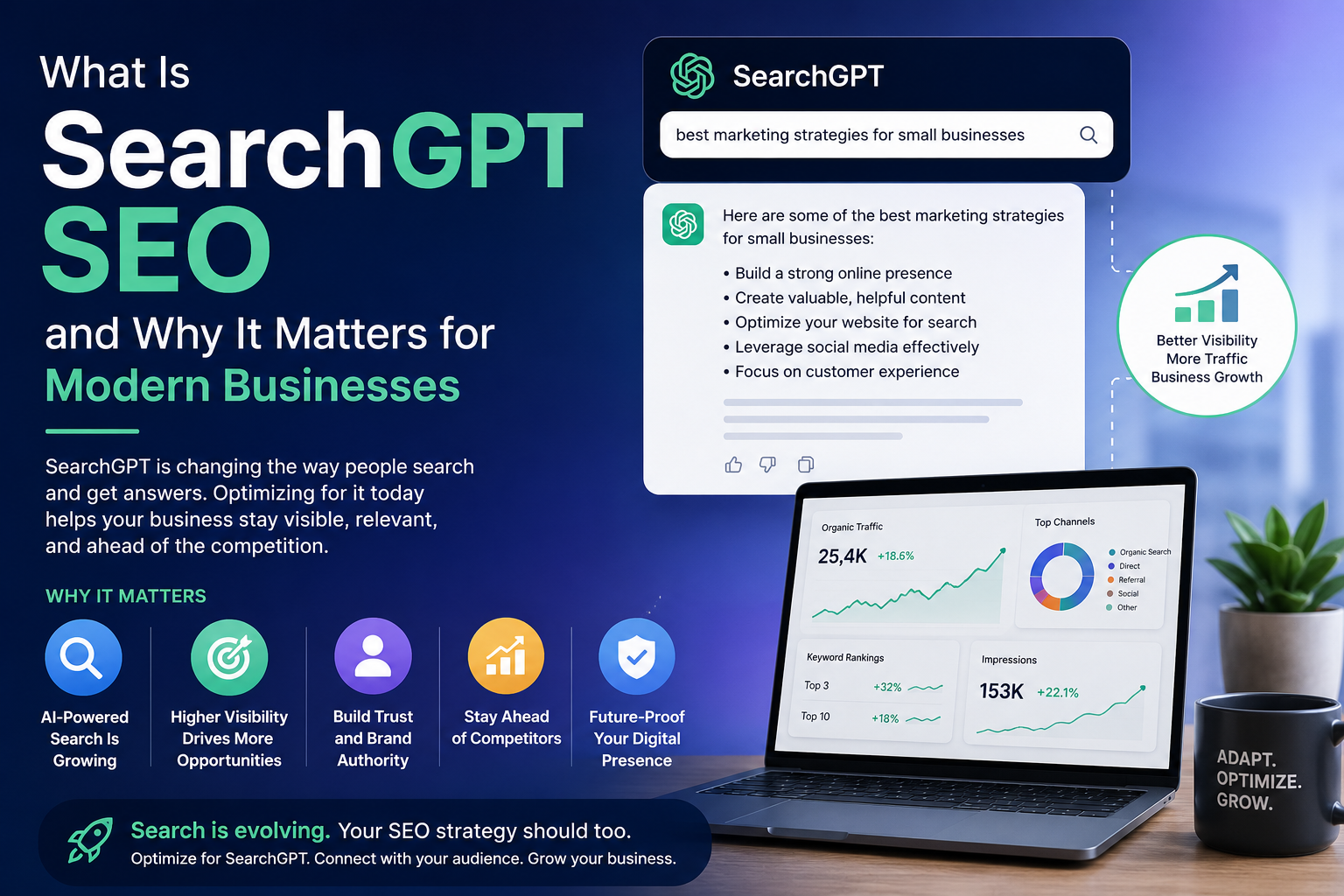
What Is SearchGPT SEO and Why It Matters for Modern Businesses

Search is no longer a list of ten blue links. For millions of users, it is a conversation. SearchGPT is OpenAI's answer to that shift, and the businesses that understand how to optimize for it are already capturing audiences that traditional SEO alone cannot reach. The introduction of AI-native search engines has created a new category of digital visibility that most businesses have not yet addressed. While search engine optimization has long focused on Google rankings, a significant portion of search behavior is now moving toward conversational AI platforms. SearchGPT, developed by OpenAI, is one of the most consequential of these platforms, and optimizing for it requires a distinct and deliberate approach.
This guide explains what SearchGPT SEO is, how it differs from traditional search optimization, and why it is becoming a critical component of any comprehensive AI SEO services strategy.
What Is SearchGPT?
SearchGPT is OpenAI's AI-powered search experience that delivers conversational, sourced answers to user queries in real time. Unlike traditional search engines, it synthesizes information from multiple web sources and presents a direct response with citations, rather than a list of links for the user to explore independently. It uses a combination of Bing's index and real-time web access, filtered through large language model reasoning, to decide which sources to surface and cite.
This distinction matters enormously for businesses. When a user asks SearchGPT a question about a product, service, or industry topic, they receive a curated answer, not ten options. The businesses cited in that answer receive attention. The businesses not cited receive nothing, regardless of how well their pages rank on Google.
How SearchGPT Retrieves and Ranks Information
Understanding SearchGPT SEO begins with understanding how the platform selects its sources. Traditional ranking factors such as backlink volume and keyword density play a reduced role. What matters most is whether your content is structured in a way that an AI system can extract, trust, and cite accurately.
Factual accuracy is the primary filter. SearchGPT deprioritizes sources that contain unsupported claims, outdated information, or internal contradictions. Clear logical organization allows the system to extract specific answers without ambiguity. Genuine topical authority, demonstrated through consistent, comprehensive coverage of a subject area, signals that a source is reliable enough to cite repeatedly.
These are not new content principles. They align directly with what Google's Search Quality Evaluator Guidelines describe as the foundations of high-quality pages: Experience, Expertise, Authoritativeness, and above all, Trust. SearchGPT SEO is, in many ways, E-E-A-T taken to its logical conclusion.
How SearchGPT SEO Differs from Traditional SEO
Many businesses assume that strong Google rankings automatically translate to visibility in AI search results. This assumption is only partially correct. While domain authority and content quality matter in both contexts, the optimization requirements are meaningfully different.
Traditional SEO rewards keyword placement, backlink acquisition, and technical site health. These factors still matter for SearchGPT, but they are not sufficient on their own. SearchGPT additionally rewards content that is written in a conversational, question-answering format, cites credible sources within the body of the content, uses structured data to clarify what type of information the page contains, and is updated regularly to reflect current facts.
A page optimized purely for keyword rankings may never appear in a SearchGPT citation. A page written to genuinely answer a specific question with accurate, well-organized information may be cited consistently even without a dominant backlink profile.
Why SearchGPT SEO Matters for Business Growth Right Now
The businesses appearing in SearchGPT citations today are not necessarily the largest or the oldest. They are the ones whose content is accurate, well-organized, clearly sourced, and written by genuine subject matter experts. This creates a meaningful early-mover opportunity for businesses willing to invest in content quality before their competitors recognize the shift.
There is also a compounding trust effect to consider. When SearchGPT cites your content as a trusted source, it reinforces your brand authority across the entire AI search ecosystem. Users who encounter your business through an AI-generated answer associate it with expertise and reliability at a level that paid advertising rarely achieves. This downstream impact on brand trust, conversion rates, and customer retention is significant and measurable over time.
Working with the best seo company for SearchGPT optimization means gaining access to specialists who understand both the technical and editorial requirements of AI search visibility. Strong content in isolation is not enough. It must be structured, attributed, technically sound, and consistently maintained to remain citation-eligible as these platforms continue to evolve.
The Core Elements of a SearchGPT SEO Strategy
A professional SearchGPT SEO strategy covers six areas that work together to build and maintain AI search visibility.
The first is entity and authority mapping, which identifies the specific topics and questions your business needs to own and builds content that establishes verifiable expertise in each area.
The second is structured data implementation, which applies schema markup across all key pages so AI systems can clearly understand content type, authorship, and factual claims.
The third is conversational query coverage, which means optimizing content for the way people ask questions naturally, not just for how they type keywords into a search bar.
The fourth is source citation and fact verification, ensuring every factual claim in your content is accurate and citable, since AI systems deprioritize sources containing unsupported or conflicting information.
The fifth is content freshness, because SearchGPT accesses real-time web content and consistently favors pages that are regularly updated over stale content regardless of original quality.
The sixth is cross-platform AI visibility monitoring, which tracks citation appearances across SearchGPT, Google AI Overviews, Perplexity, and Microsoft Copilot to measure presence and identify gaps.
Conclusion
SearchGPT SEO is not a future consideration. It is a present and growing channel already reshaping how consumers discover businesses, evaluate options, and make decisions. The principles that drive SearchGPT citations, factual accuracy, genuine expertise, clear structure, and trusted sourcing, are the same principles that define high-quality content across every search platform.
SEO Discovery is a full-service digital marketing agency with 22 years of experience and 400 in-house specialists delivering measurable results across 50 countries. Our AI SEO services include dedicated SearchGPT optimization, generative engine visibility strategy, technical SEO, and content authority programs designed to position your business as a trusted source across every AI search platform that matters.
Contact us today to get a free AI search visibility audit and find out exactly where your business stands in SearchGPT, Google AI Overviews, and Perplexity results.