


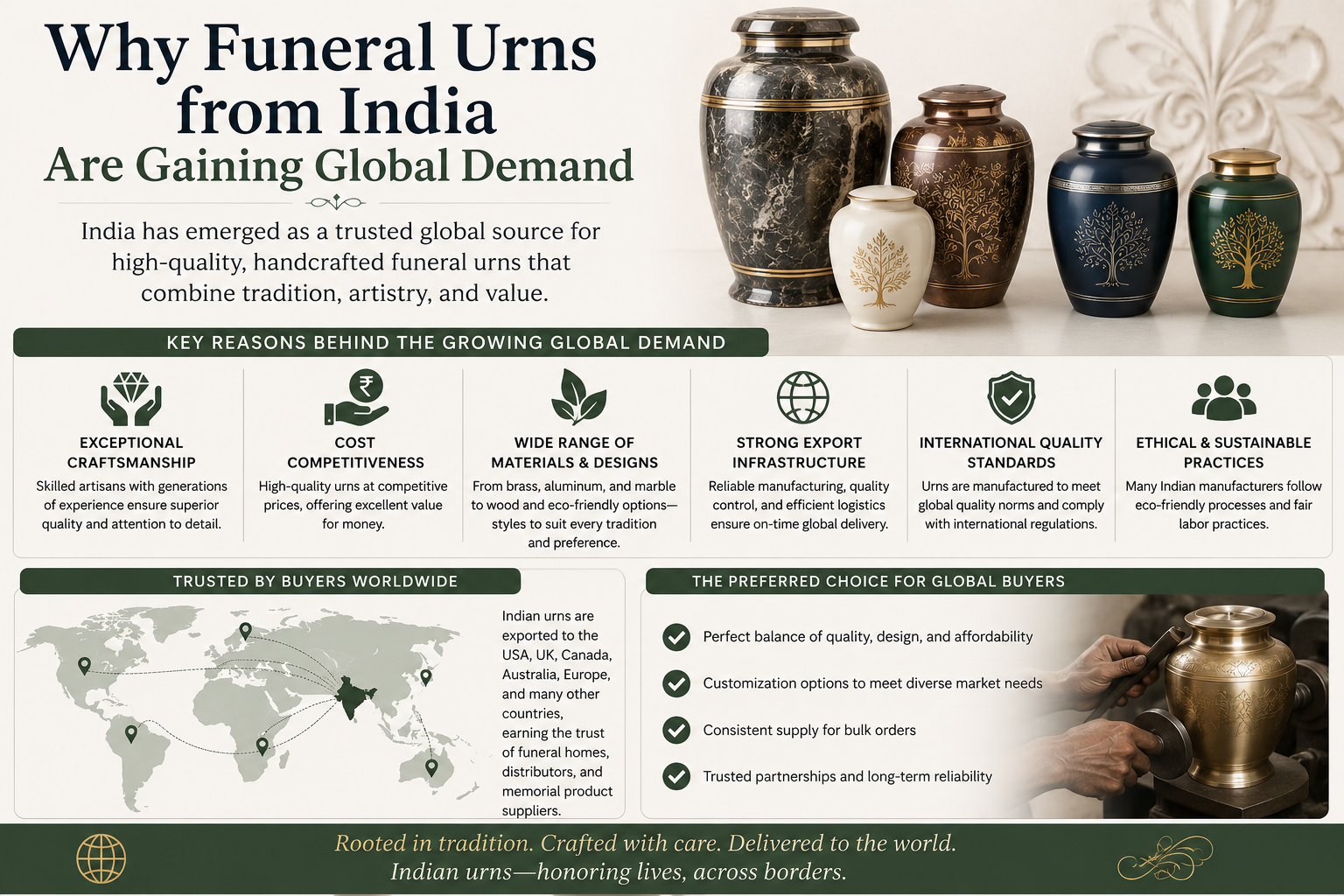
Why Funeral Urns from India Are Gaining Global Demand
A procurement manager in Texas rejects a full container because the threaded lid alignment shifts during humidity exposure. The supplier blames shipping conditions. The buyer loses a retail client anyway. That’s the part many overseas buyers discover too late when sourcing Funeral Urns internationally.
India’s export market for memorial products has changed fast over the last decade. Buyers looking for Custom Designed Urns, premium metal finishes, hand-crafted wooden urns, and scalable OEM production are now sourcing directly from Funeral Urns Manufacturers in India because pricing alone is no longer the deciding factor. Reliability is. Material consistency is. And frankly, some low-cost factories outside India still struggle with repeat finish accuracy across large production runs.
Why Buyers Are Replacing Old Supply Chains with Indian Manufacturers
The North American, European, and Japanese markets show increasing demand for funeral products as the population continues to age. The National Funeral Directors Association anticipates the U.S. cremation rate will surpass 80% in 2045, signifying a sustained demand on memorial products. As a result, wholesalers have to find suppliers who can meet high-volume and specialty needs within tight lead times.
Because of its unique placement of hand-finishing and metal-working skills alongside craftsmanship in hardwoods with the capacity to manufacture for export, India has become a leading source region.
Moradabad alone handles a significant share of India’s handicraft and memorial export manufacturing, with thousands of export containers moving annually through Nhava Sheva and Mundra ports.
And yet, buyers still make the same mistake repeatedly: they evaluate urn suppliers using catalog photography instead of production controls.
That usually ends badly.
Specification Details Buyers Actually Need Before Ordering
Material Selection Changes Everything
Most Adult Urns Suppliers offer aluminum, brass, stainless steel, wood, ceramic, and biodegradable options. The material affects more than appearance.
Brass urns hold engraving better over time. Aluminum reduces shipping weight by nearly 35–40% compared to solid brass models. Wooden urns require tighter humidity control during storage and transit. Ceramic pieces photograph beautifully but generate higher breakage claims if inner packaging is weak.
Nobody tells you how often importers overlook internal threading quality on screw-top lids until customers begin returning products.
A lid that jams after six months destroys retailer confidence fast.
Finish Consistency Is Harder Than Buyers Expect
Electroplating variation remains one of the biggest issues in memorial product exports. A supplier may send an excellent pre-production sample and then fail to maintain the same antique finish across 2,000 units.
That happens more often than suppliers admit.
Reliable Funeral Urns Manufacturers maintain documented finish batches and sample retention records. If a factory cannot show batch tracking during discussions, expect shade variation later.
Customization Capacity Separates Factories from Traders
Many businesses calling themselves Custom Designed Urns Manufacturers are actually trading companies outsourcing production to multiple workshops.
That creates chaos.
Laser engraving may come from one vendor. Powder coating from another. Packaging from somewhere else entirely. When defects appear, nobody accepts responsibility.
Buyers should verify whether customization happens in-house or through subcontractors before placing MOQ-based orders.
Packaging Specs Matter More Than Catalog Design
A strong urn design means nothing if packaging collapses during international freight movement.
Here’s a detail many buyers miss: double-wall export cartons with molded foam inserts reduce breakage claims significantly during ocean transit exceeding 35 days. Some suppliers still use low-density thermocol to save cents per carton.
That saving becomes your warranty problem later.
The Spec Detail Most Buyers Skip During Supplier Audits
Thread Tolerance and Closure Testing
Most retailers never mention it publicly, but closure defects create recurring complaints in Adult Urns categories.
A proper supplier tests lid threading repeatedly during production runs, not just during sampling. Cross-threaded lids often appear only after plating or lacquer application changes dimensional accuracy slightly.
A supplier saying “we inspect visually” is not giving you a quality system. That’s guesswork dressed up as reassurance.
Moisture Resistance for Wooden Urns
Wooden Custom Designed Urns exported to humid regions require controlled seasoning before carving and finishing.
Otherwise, minor expansion causes lid warping.
Which means a beautiful handcrafted urn can fail after sitting in warehouse storage for four months.
That’s expensive to explain to retailers.
Five Supplier Evaluation Criteria That Actually Matter
1. Ask for Defect Ratios — Not Marketing Brochures
Good suppliers track defect percentages internally.
Bad suppliers answer with vague phrases like “very minimal issues.”
That usually means they either do not measure defects or do not want buyers seeing the numbers.
2. Verify Export Experience by Country
Exporting to Germany differs from exporting to the United States. Packaging regulations, labeling expectations, and documentation standards vary.
Experienced Funeral Urns Suppliers in India understand those differences already.
3. Inspect Finish Repeatability
Request production photos from three separate batches produced months apart.
Most factories can make one excellent sample. Repeating it consistently is the real test.
4. Evaluate Communication Speed During Problems
Late replies during sampling become disastrous during container delays.
A supplier who disappears for four days after a quality complaint will become impossible during peak shipping season.
5. Confirm MOQ Flexibility Honestly
Some manufacturers of Adult Urns in India may show low MOQs in public but later put mixed-container obligations on buyers, so be careful.
Get written confirmation early.
How Indian Funeral Urn Manufacturing Protects Buyer Margins
Labor Skill Still Impacts Finish Quality
Hand-applied antique finishes, engraving alignment, and polishing quality remain labor-sensitive processes. India still maintains a skilled artisan manufacturing base that many competing regions lost years ago.
That matters for premium memorial products.
Mixed Material Production Reduces Vendor Dependency
Many Indian factories produce metal, wood, marble, and keepsake urn collections together.
Which means buyers avoid splitting sourcing across four suppliers.
Fewer suppliers usually means fewer logistics problems.
Export Infrastructure Has Improved Significantly
Indian export timelines were once criticized heavily for inconsistency. Some criticism was deserved.
There have been significant improvements in the coordination of freight and handling across western shipping corridors connecting to the Mundra and Nhava Sheva ports since 2021.
OEM Capability Supports Private Labels
Due to the ability of these factories to offer low-volume production customization, Private Label memorial brands increasingly partner with Custom Designed Urns Suppliers in India, compared to big factories in other countries.
Currency Advantage Helps Long-Term Contracts
Indian manufacturing remains cost-competitive for international buyers because of labor economics and exchange-rate positioning against Western currencies.
Still, buyers chasing the absolute cheapest quote usually create their own future problems.
The lowest-priced supplier in memorial products often becomes the most expensive supplier six months later.
Why India’s Manufacturing Geography Matters
Moradabad Remains a Major Export Hub
Moradabad continues to dominate metal handicraft and memorial product manufacturing due to supplier density, artisan labor, and export familiarity.
That concentration helps buyers source multiple urn styles faster.
Northern India Supports Wood and Metal Production Together
The manufacturing clusters in and around Uttar Pradesh enable the procurement of both wood and metal funeral urns without dispersing production over long distances.
Freight consolidation becomes easier.
Access to Major Ports Reduces Transit Delays
Factories connected efficiently to Mundra and Nhava Sheva ports generally manage export schedules better than inland operations dependent on multiple transport transfers.
Which sounds minor until a missed vessel booking delays retail inventory by three weeks.
About Us — Built Around Export Reality, Not Catalog Promises
At Square N Circle, we work directly with global wholesalers, procurement teams, memorial brands, and distributors looking for dependable production from experienced Funeral Urns Manufacturers in India.
We’ve spent years refining export packaging, finish consistency, and OEM production systems because buyers rarely lose money on samples. They lose money on repeat orders that fail to match earlier shipments.
In 2021, we stopped using one imported lacquer line after multiple overseas buyers reported inconsistent gloss retention in high-humidity storage environments. We replaced the process entirely instead of arguing over claims.
That decision cost us money short term.
It protected long-term buyer relationships.
Our production capabilities include Adult Urns, keepsake urns, pet urns, engraved memorial products, and fully Custom Designed Urns for private-label programs across international markets.
Send the Right Information Before Requesting a Quote
Most pricing delays happen because buyers send incomplete specifications.
If you’re sourcing from Funeral Urns Suppliers in India, send material preference, finish reference images, estimated order quantity, packaging requirements, engraving needs, and target destination country in the first inquiry.
We usually respond within 24 business hours.
For OEM orders, MOQ discussions depend on finish complexity and packaging configuration rather than just product size alone.
Conclusion
Global buyers are turning toward Indian Funeral Urns Manufacturers because consistency, customization, and export readiness matter more now than simply finding the cheapest factory. The suppliers winning long-term contracts are the ones controlling finish quality, packaging integrity, and communication speed under pressure. As cremation demand keeps rising globally, experienced Funeral Urns Suppliers in India will continue playing a larger role in private-label memorial product manufacturing.
Here is another blog you might be interested in.
Custom Designed Urns: What Buyers Learn After Their First Bad Shipment
FAQs
Are Indian funeral urn manufacturers a good match for private label brands?
Yes. Indian manufacturers are a good option for buyers who need low volume production with customized options. Many factories in India engrave, add custom finishes, and package branded items. However, some suppliers don't ensure confidentiality of their designs. It is advisable for buyers to check where production is done before they send their designs.
What materials are the most popular exports for adult urns?
Brass, aluminum, wood, stainless steel, and ceramic are the most popular materials for exports. Brass and aluminum are the most popular materials for urns as they are durable and efficient for engraving and shipping.
What is the best way for buyers to ensure an Indian custom designed urns supplier is trustworthy?
Trust is earned when a supplier produces sample photos of the batch, tests submission packages, or provides documentation of their exports. A trustworthy urns supplier will be willing to provide information on how they handle defective products. If a supplier is reluctant to share their rejection percentage, that is a big red flag.
Do adult urn manufacturers in India provide low MOQs?
Yes, they do. This is especially true if a buyer is interested in a mixed-product container program. Fully custom molds and specialized finishes may drive up the MOQs due to an increase in setup costs.
What is causing the increase in demand for funeral urns in India?
India is home to a unique combination of skilled, hand-finish labor, customization ability, and large-scale export manufacturing all at a competitive price. Buyers also get the added benefit of a wider range of materials that can be procured from a single supplier.
Are all custom designed urns manufacturers actual factories?
No. Many of these suppliers are trading companies that coordinate outsourced production. This is not bad, but buyers need to be clear who has ownership of production quality and who has ownership for defective items.
As a buyer, what packaging standards do you expect from Indian Funeral Urns Suppliers?
Significant freight damage can be prevented when you use double-wall cartons with molded foam inserts, moisture-resistant inner protection, and drop-tested export packaging. There is insufficiently protective packaging, and it is a detrimental obstacle to cross-border shipments of almost all memorial products.

 English
 Arabic
 Spanish
 Portuguese
 Deutsch
 Turkish
 Dutch
Dutch
 Italiano
 Russian
 Romaian
 Portuguese (Brazil)
 Greek
Greek