


Driver Behavior Annotation for In-Cabin Monitoring AI: A Guide
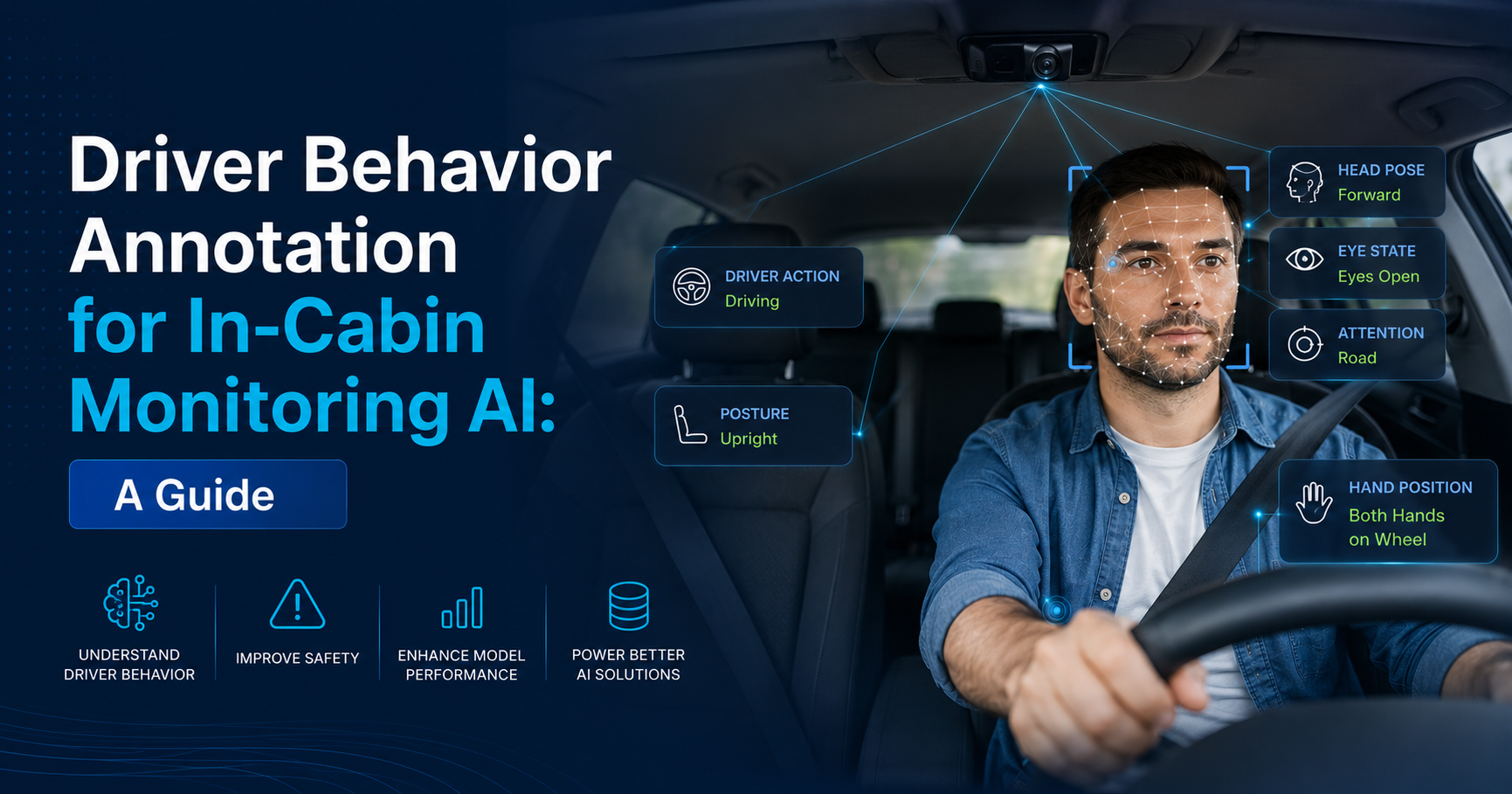
A driver glancing at a navigation screen for 1.5 seconds presents a different risk profile from the same driver looking at their phone for four seconds while the vehicle is moving at 100 kilometres per hour. Both involve the driver looking away from the road. The difference in duration, in head and gaze direction, in what the hand is doing simultaneously is exactly what driver monitoring AI needs to learn to distinguish. It learns that distinction from labeled training data where annotators have marked each behaviour with precise temporal boundaries, accurate activity class labels, and consistent treatment of the visual, manual, and cognitive dimensions of each distraction event. In-cabin monitoring annotation for driver behaviour is the process of producing that labeled data. This post explains what driver behaviour annotation involves, how secondary task annotation is structured, and what makes behavioural annotation harder than other cabin annotation tasks.
What Driver Behaviour Annotation Covers
Driver behaviour annotation classifies what the driver is doing at each point in a recording not just their physiological state but their active engagement with tasks, objects, and activities inside and outside the vehicle. The annotation taxonomy for driver behaviour is more complex than for driver state monitoring because behaviour involves temporal extent, object interaction, and often simultaneous multi-task engagement that must all be captured in the labels.
The primary behaviour categories in driver monitoring annotation include forward road attention, visual distraction (looking away from the road without physical interaction), manual distraction (hand interaction with an object), visual-manual distraction (looking at an object while physically interacting with it), cognitive distraction (talking on hands-free phone, engaged in conversation that reduces road attention), and secondary task engagement (activities unrelated to driving that are visually or manually demanding). Each category trains a different detection model and each has specific annotation requirements.
The distinction between these categories matters for the deployed safety system. A visual-only distraction that resolves in under two seconds does not represent the same risk as a visual-manual distraction sustained over five seconds. An annotation program that conflates these into a single "distraction" category produces a model that cannot distinguish risk levels either alerting too frequently on brief, low-risk glances or not alerting soon enough on sustained, high-risk secondary tasks.
How Secondary Task Annotation Is Structured
Secondary task annotation identifies and labels the specific activity the driver is engaging in when their attention is not fully on driving. The most safety-relevant secondary tasks for driver monitoring training data are mobile phone use, eating and drinking, operating in-vehicle controls, reading, and grooming.
Mobile Phone Use Annotation
Mobile phone use annotation is one of the most important secondary task categories because it combines visual distraction (looking at the screen), manual distraction (holding and interacting with the device), and cognitive distraction (processing the content on the screen) simultaneously. The annotation for phone use captures each of these dimensions separately through coordinated task labels rather than a single umbrella phone-use class.
The visual dimension is labeled through gaze direction annotation the driver's gaze is directed at the phone rather than at the road or mirrors. The manual dimension is labeled through hand position and object recognition the phone is in one or both hands. The temporal extent is labeled through event start and end timestamps. A driver who picks up the phone, holds it below the steering wheel (where gaze direction alone does not clearly show phone engagement), and reads the screen for four seconds produces a different visual signature than a driver looking directly at the phone in a raised position — but the risk is the same. Annotation guidelines must define how to label both configurations consistently as phone use events.
Eating and Drinking Annotation
Eating and drinking while driving is annotated as a manual distraction event with specific object classification. The annotation captures what the driver is eating or drinking, which hand is occupied, whether the other hand is on the wheel, the duration of the eating sequence, and whether the driver's gaze is on the road or on the food item during the interaction.
The temporal boundaries for eating events require specific definition because eating sequences have a complex temporal structure the driver reaches for food, brings it to their mouth, takes a bite, chews, swallows, and either reaches for more or puts the food down. The annotation taxonomy must define which phase of this sequence constitutes the active manual distraction event for the purpose of the safety alert beginning when the hand leaves the wheel to reach for the food, or beginning when the food reaches the mouth, or covering the full sequence.
For a clear explanation of how in-cabin monitoring systems work, what data they collect, and how different annotation types support each safety function in the system this in-cabin monitoring annotation covers the full pipeline from sensor data collection to AI model training.
Operating In-Vehicle Controls Annotation
Drivers interact with in-vehicle controls climate controls, audio systems, navigation interfaces, window and mirror adjustments as a normal part of driving. Some of these interactions are brief, low-risk, and performed without meaningful visual departure from the road. Others are sustained, visually demanding interactions with touchscreen interfaces that carry meaningful distraction risk.
The annotation taxonomy must distinguish between these two types. A single button press completed in under one second with no gaze departure from the forward road is categorically different from a multi-step touchscreen interaction that requires the driver to look at the screen and navigate through menus. Annotation guidelines need to define the duration and gaze departure thresholds that move an in-vehicle control interaction from the low-risk category to the secondary task distraction category.
How Temporal Segmentation Works for Behaviour Annotation
Temporal segmentation is the annotation task that gives driver behaviour data its safety-relevant structure. Every behaviour annotation involves two temporal markers the event start and the event end that together define how long the behaviour lasted. The duration of a distraction event is one of the primary predictors of accident risk in driver monitoring research. An annotation program that places temporal boundaries inconsistently across annotators produces duration measurements that do not reflect actual event durations, which produces a model that cannot accurately identify sustained distractions.
The most common source of temporal boundary inconsistency is ambiguous start and end definitions. An annotation guideline that says "mark when the driver is distracted" does not specify whether the distraction event starts when the gaze first leaves the road, when the hand first reaches toward the distraction object, or when the driver's full attention is clearly engaged with something other than driving. Different annotators will make different choices under vague guidelines, producing temporal boundaries that vary by multiple seconds across the dataset.
Annotation guidelines for behavioural temporal boundaries must define each event start and end in terms of specific observable signals with explicit examples. For phone use, the annotation guideline might define the start as the first frame where the driver's hand makes contact with the phone and the end as the first frame where the hand returns to the wheel and the gaze returns forward. This level of specificity produces consistent boundaries across annotators and duration measurements that accurately represent how long each distraction event lasted.
Event adjacency rules are also necessary. When a driver looks at their phone, puts it down, and then picks it up again within three seconds, is this one distraction event or two? When a driver finishes a phone call but continues to hold the phone for several seconds before placing it down, does the manual distraction event end when the call ends or when the phone is placed down? These scenarios occur regularly in real driving data and produce annotation decisions that affect duration calculations unless the guidelines define them explicitly.
What Makes Driver Behaviour Annotation Harder Than State Annotation
Driver behaviour annotation is harder than driver state annotation drowsiness labeling, gaze direction, head pose in two specific ways.
Behaviour annotation requires simultaneous multi-task labeling. A driver who is eating while glancing at a phone while talking to a passenger presents three simultaneous distraction dimensions that must all be captured in the annotation. Annotators working on behaviour data must manage multiple label tracks simultaneously across the video sequence, which requires more working memory, more attention management, and more specific training than single-task annotation.
Behaviour annotation requires judgment about intent and context in ways that physiological state annotation does not. A glance in the rear-view mirror is normal driving behaviour. The same glance duration toward the back seat to check on a child occupant is a distraction event. The visual signal is similar — the driver's gaze moves away from the road for approximately the same duration. The annotation decision depends on what the driver is looking at and why, which requires the annotator to understand driving behaviour context rather than simply measuring observable visual features.
This context dependency means that annotator selection and training matter more for behaviour annotation than for most other cabin annotation tasks. Annotators who do not drive or who have limited experience observing driver behaviour make systematic annotation errors on context-dependent scenarios that more experienced annotators do not make. Domain-expert review should be applied to behaviour annotation batches at a higher rate than to state annotation batches, specifically targeting the context-dependent scenarios where inexperienced annotators are most likely to make incorrect judgments.
Conclusion
Driver behaviour annotation for in-cabin monitoring AI produces the temporal, multi-task labeled data that allows safety systems to distinguish between normal driving attention patterns and the specific secondary task engagements that produce accident risk. The annotation tasks secondary task classification, temporal event boundary placement, multi-task labeling, context-dependent distraction classification are harder than driver state annotation and require more domain expertise, more specific annotation guidelines, and more intensive QA review of context-dependent scenarios. Programs that invest in these requirements produce training datasets that support driver monitoring systems capable of identifying the specific risk-relevant behaviour patterns they were designed to detect.


 English
 Arabic
 Spanish
 Portuguese
 Deutsch
 Turkish
 Dutch
Dutch
 Italiano
 Russian
 Romaian
 Portuguese (Brazil)
 Greek
Greek