


Geological Formation of Chima Pink Granite and Why It Matters for Buyers of Chima Pink Granite Slabs
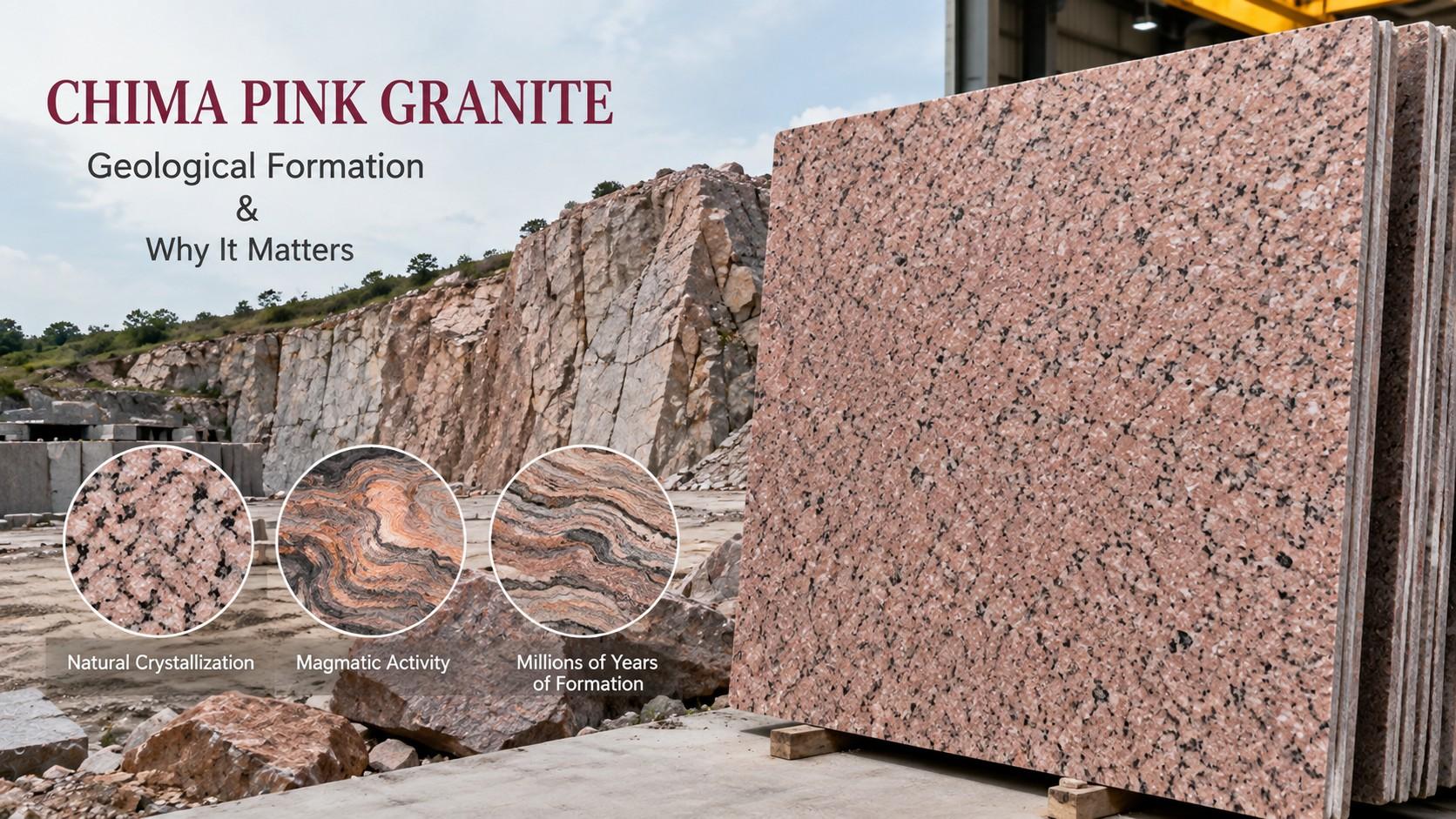
For buyers sourcing Chima Pink Granite slabs in commercial quantities, the stone’s geological formation is more than a matter of academic interest. The way the granite crystallized, cooled, fractured, and later became exposed at the quarry can influence block integrity, mineral distribution, slab consistency, natural fissures, sawing behavior, and the amount of usable material obtained from a block.
Chima Pink Granite is commercially associated with granite quarries in Rajasthan, particularly the Jalore area, and is commonly described as having a light pink to peach-toned background with contrasting black, gray, white, or cream mineral particles. Some trade sources also identify the material under names such as Cheema Pink or Imperial Pink.
For U.S. importers, distributors, fabricators, architects, and project buyers, understanding this geological background helps distinguish normal natural variation from genuine quality concerns. It also provides a better basis for evaluating rough granite blocks before a container is processed and shipped.
How Chima Pink Granite Formed in Rajasthan
Chima Pink Granite is commercially linked with the granitic rocks of the Jalore region of Rajasthan. Geological research on the Jalore area places these rocks within the Malani Igneous Suite, a major Neoproterozoic igneous province of western Rajasthan. Studies describe Jalore granite as part of a system of granitic plutons emplaced during ancient magmatic activity.
A granite pluton forms when molten or partially molten material cools and crystallizes slowly beneath the Earth's surface. Slow underground cooling allows mineral crystals to develop rather than producing the very fine texture associated with rapidly cooled volcanic rocks.
Research around Jaswantpura in Jalore District has identified several granite varieties, including coarse to medium-grained biotite granites, two-mica granites, hornblende-bearing granites, and finer-grained biotite granites. The same research indicates that large granitic bodies were emplaced during periods of crustal extension in the region.
That geological history matters commercially because the final stone is not simply a uniform mass of pink material. Its appearance and physical behavior result from the interaction of different minerals, crystal sizes, internal structures, and later geological stresses.
Why the pink background develops
The pink appearance found in Jalore-related granite is strongly associated with potassium-rich feldspar. Regional studies describe Jalore granite as containing abundant feldspar and quartz, with biotite and other minerals occurring as accessory phases. Published geological work also describes light-pink Jalore granite with pink, white, or brown feldspar, quartz, and dark biotite.
Commercial descriptions of Chima Pink Granite similarly identify a pink base with darker and lighter mineral speckling.
The result is the recognizable visual character seen across Chima Pink Granite slabs: a warm pink or peach field interrupted by contrasting mineral grains rather than prominent, continuous veins.
Mineral Distribution Gives Chima Pink Its Character
One of the most useful geological factors for a buyer is mineral distribution.
Unlike a manufactured surface, granite records the arrangement of minerals that crystallized together thousands of millions of years ago. Changes in the proportion, size, orientation, or concentration of feldspar, quartz, mica, and darker accessory minerals can alter the appearance of individual blocks and slabs.
Published commercial descriptions of Chima Pink identify quartz, feldspar, and mica among its constituent minerals, while regional Jalore studies confirm feldspar and quartz as major components with biotite and other minerals present in different granite varieties.
For a U.S. buyer ordering a large quantity of granite slabs, this has a practical consequence: a slab that matches a small approved sample may still show natural differences in grain density or background tone.
Natural variation is not automatically a defect
A professional inspection should distinguish between:
- Normal differences in pink background tone
- Changes in black, gray, white, or cream mineral concentration
- Variation in grain size
- Local pattern movement
- Genuine cracks, open fissures, or structurally significant weaknesses
Commercial sources describe Chima Pink as a material with natural variation in its pink background and mineral speckling.
For large U.S. projects, the purchasing specification should therefore define the acceptable visual range rather than simply requiring every slab to look identical.
Geological Structure Can Influence Rough Granite Blocks
The most important commercial connection between geology and export quality often begins before slab production.
A quarry block can appear sound externally while containing internal discontinuities, healed fractures, joints, or zones of weakness. Regional geological studies of Jalore granites document joint systems and fractures associated with geological structures and cooling processes.
This does not mean every Chima Pink block contains problematic fractures. It means that block selection must consider internal structure rather than relying solely on the visible quarry face.
For an international granite slab exporter & supplier, proper block evaluation should consider:
Block integrity
Large, sound blocks generally provide a more predictable basis for slab production. Excessive cracking or irregular internal structure can reduce recovery and increase the likelihood of breakage during cutting.
Fracture orientation
The direction and concentration of natural discontinuities can influence how a block behaves when it is sawn. A fracture that looks minor on a rough surface may become more apparent once the stone is opened into slabs.
Grain and mineral concentration
Localized mineral concentrations may produce visible changes between adjacent slabs. This becomes particularly relevant when a U.S. buyer needs a visually coordinated batch for countertops, vanities, wall panels, or a commercial interior.
Weathered material
Surface weathering can make the outer portion of a block less representative of the sound material deeper inside. Quarry selection therefore affects more than appearance; it can influence yield and processing consistency.
Why Geological Formation Matters During Slab Production
Once a Chima Pink block reaches the processing facility, its geological history continues to influence production.
Sawing exposes a two-dimensional representation of a three-dimensional geological body. The same block can therefore reveal changes in grain distribution, mineral concentration, or internal discontinuities as cutting progresses.
For buyers of Chima Pink Granite slabs, this is one reason block photographs alone are not enough for a high-volume order.
Sawing and slab recovery
A structurally sound block with relatively consistent internal characteristics can generally be processed more predictably than a block containing numerous natural weaknesses.
When a slab line encounters a discontinuity, several outcomes are possible:
- A visible fissure may become more prominent after cutting.
- A localized weakness may reduce usable slab area.
- Resin treatment may be considered depending on the material and processing specification.
- A slab may require additional inspection before being approved for fabrication.
- Breakage during processing can reduce commercial recovery.
The geological structure does not determine a single guaranteed yield percentage. Yield depends on block geometry, cutting equipment, slab thickness, internal conditions, production practices, and quality requirements.
Polishing reveals mineral relationships
Polishing does not create the stone's pattern. It increases the visual contrast between its mineral components.
On Chima Pink Granite, the polished surface can emphasize the relationship between the pink feldspar-rich background and darker or lighter mineral grains. This is one reason why a polished production sample should be compared directly with the approved reference sample rather than relying only on photographs.
What Geological Formation Means for U.S. Commercial Buyers
A buyer importing from an Indian granite exporter should connect geological information with practical procurement controls.
For a small residential order, modest visual variation may be acceptable. For a large hotel, multifamily development, office project, or distributor inventory program, the tolerance can be much tighter.
A procurement specification for Chima Pink Granite should identify:
- Approved color range
- Expected mineral and grain variation
- Required slab thickness
- Permitted natural fissures
- Requirements for open cracks or structurally significant fractures
- Surface finish
- Calibration requirements where applicable
- Slab dimensions
- Acceptable edge condition
- Sample approval procedure
- Inspection requirements before shipment
Sample approval should be more than a single slab
A single sample can show the general character of the material but may not represent the full range of a quarry batch.
For a larger order, buyers should request representative photographs or videos showing multiple slabs from the intended production batch. This gives the purchasing team a better understanding of background tone, grain distribution, and natural variation.
For projects requiring tight visual coordination, reviewing consecutive slabs from the same block or closely related blocks can be particularly useful.
Practical Sourcing Checklist for Chima Pink Granite Slabs
Before approving a commercial shipment, U.S. buyers should verify the following.
1. Confirm the source and commercial identity
Chima Pink is also marketed under related names, so the purchase specification should identify the exact commercial material being approved.
2. Review the rough granite blocks before processing
Request block photographs or videos showing all accessible faces, especially where block integrity is a major concern.
3. Compare the actual production batch with the reference sample
Check the pink background, dark mineral distribution, grain size, and overall visual movement.
4. Inspect for structural issues
Look for open cracks, significant fissures, edge breakage, or other conditions that could affect fabrication.
5. Confirm slab thickness and dimensions
Thickness requirements should be documented before production rather than assumed from standard market offerings.
6. Approve the finish separately
A polished surface can present the mineral pattern differently from a honed, flamed, brushed, leathered, or other textured finish.
7. Document acceptance criteria before container loading
Clear specifications reduce disagreements between supplier, buyer, fabricator, and inspection personnel.
8. Inspect the packed shipment
Slabs should be securely supported and packed to reduce movement and impact damage during international transportation.
For a large order, pre-shipment inspection is especially valuable because it provides an opportunity to identify problems before the material reaches the U.S. destination and enters local fabrication schedules.
Where Chima Pink Granite Can Make Sense
The geological characteristics and relatively consistent speckled appearance of Chima Pink make the material relevant to applications where a warm, mineral-rich granite appearance is desired. Commercial sources list uses including countertops, flooring, stairs, wall cladding, exterior applications, window sills, landscaping, and architectural elements.
For U.S. commercial projects, suitability should still be evaluated against the specific application, finish, fabrication method, exposure conditions, and project specification.
For example, a fabricator purchasing slabs for kitchen countertops may focus heavily on slab soundness, dimensions, finish quality, and visual matching. A distributor stocking the material may place greater emphasis on repeatability across multiple containers and batch identification.
The same geological characteristics therefore have different commercial implications depending on the intended use.
Why Geology Should Be Part of the Purchasing Conversation
The geological formation of Chima Pink Granite helps explain why two blocks from the same broad source can produce slightly different slab appearances and why block selection matters before processing begins.
Research establishes that Jalore granites formed within an ancient Neoproterozoic magmatic system and include multiple granite varieties with different textures and mineralogical characteristics. Commercial Chima Pink material is associated with the Jalore region and is characterized by a pink-toned background with contrasting mineral grains.
That geological history translates directly into procurement considerations:
formation → mineral composition → internal structure → block quality → sawing behavior → slab appearance → usable yield.
For professional buyers, this chain is more useful than treating Chima Pink simply as a color category.
Conclusion
The geological formation of Chima Pink Granite matters because the stone's appearance and processing behavior begin deep in its geological history. Its association with the Jalore granitic terrain of Rajasthan, ancient plutonic formation, feldspar-rich mineral character, and natural internal structure help explain the pink background, contrasting mineral grains, and variation that buyers encounter in commercial production.
For U.S. importers and project buyers, the practical lesson is clear: evaluate rough granite blocks and Chima Pink Granite slabs as geological material, not as a manufactured product with perfectly repeatable characteristics. Block inspection, representative sample approval, structural checks, visual grading, thickness confirmation, and documented pre-shipment inspection can significantly improve sourcing decisions.
For upcoming projects, buyers can request Chima Pink Granite product details, representative slab photographs or videos, available block information, required dimensions and thicknesses, finish options, and export specifications from a qualified granite slab exporter & supplier. Providing project quantity, application, preferred finish, and acceptance criteria allows the supplier to prepare a more relevant commercial quotation.


 Arabic
 French
 Spanish
 Portuguese
 Deutsch
 Turkish
 Dutch
Dutch
 Italiano
 Russian
 Romaian
 Portuguese (Brazil)
 Greek
Greek