


PFAS Waste Management Market Size, Trends, Share & Industry Outlook 2026–2036
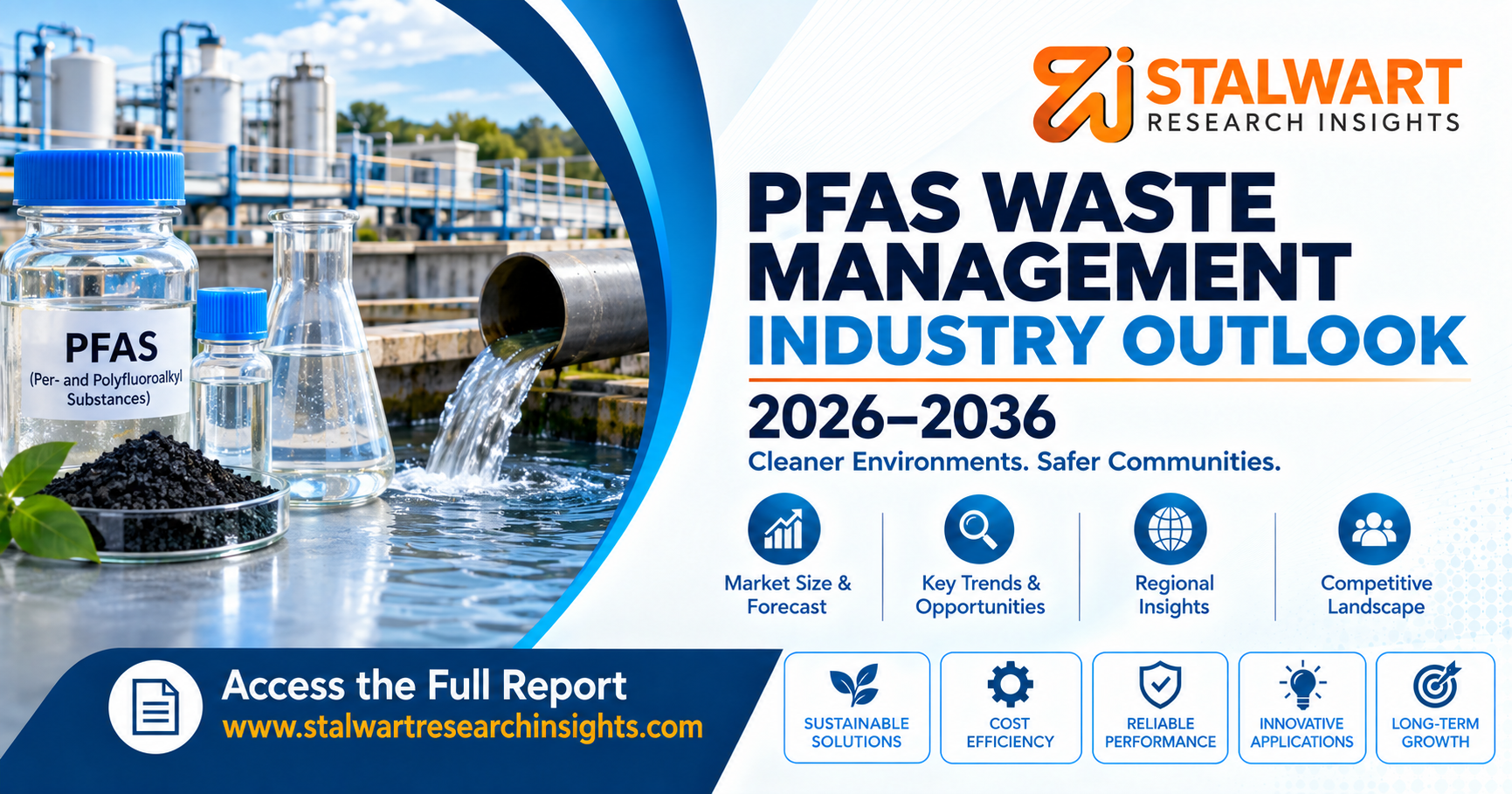
Overview of the Market:
The global PFAS waste management market covers technologies and services for the collection, treatment, destruction, disposal, and remediation of PFAS-contaminated waste streams. Market development is being supported by regulatory action, increasing public concern about persistent chemical contamination, and the need to manage PFAS-containing water, soil, sludge, spent treatment media, and other waste. Emerging solutions include high-temperature treatment, plasma-based destruction, advanced oxidation, electrochemical processes, and mobile on-site treatment systems.
Market Size & Growth: The global PFAS waste management market is projected to reach USD 7.08 billion by 2036, registering a compound annual growth rate (CAGR) of 11.4% between 2026 and 2036.
Access the Full Report PDF Here:
https://www.stalwartresearchinsights.com/request-sample/pfas-waste-management-industry-outlook
Key Market Trends:
- Increasing regulatory scrutiny of PFAS contamination
- Growing demand for PFAS destruction and remediation technologies
- Rising adoption of on-site and mobile treatment systems
- Development of advanced thermal destruction technologies
- Increasing use of plasma-based PFAS treatment
- Growing research into electrochemical oxidation
- Rising demand for treatment of contaminated water and soil
- Increasing investment in PFAS monitoring and remediation
- Development of scalable and energy-efficient treatment solutions
- Growing focus on technologies that minimize secondary PFAS releases
Analytical Tool:
- PORTER's Five Forces Analysis
- PESTEL Analysis
- SWOT Analysis
- Value Chain Analysis
- Market Attractiveness Analysis
- Competitive Landscape Analysis
- Market Dynamics Analysis
- Regional Growth Analysis
Regional Analysis:
- North America: A major market, supported by regulatory activity, industrial contamination concerns, remediation programs, and investment in PFAS treatment infrastructure.
- Europe: Growing demand is linked to environmental regulations, chemical restrictions, water-quality requirements, and circular-economy initiatives.
- Asia Pacific: Industrial expansion, increasing environmental awareness, and developing regulatory frameworks are creating opportunities for PFAS waste management technologies.
- Middle East & Africa: Water-security requirements and environmental remediation projects are creating emerging opportunities.
- South America: Increasing environmental monitoring and industrial waste-management requirements are supporting market development.
SWOT Analysis:
Strengths
- Growing regulatory demand for PFAS management
- Increasing need for specialized treatment technologies
- Broad applications across water, soil, sludge, and industrial waste
- Expanding environmental remediation infrastructure
Weaknesses
- High treatment and disposal costs
- Complex PFAS destruction requirements
- Limited availability of specialized treatment infrastructure
- Lack of standardized approaches in some markets
Opportunities
- Mobile and on-site treatment systems
- Advanced PFAS destruction technologies
- Industrial wastewater remediation
- Contaminated-site restoration
- Development of cost-effective scalable solutions
Threats
- Technological uncertainty
- Regulatory changes across jurisdictions
- Treatment residual-management challenges
- High infrastructure investment requirements
- Potential environmental-release risks from poorly controlled treatment or disposal
PESTEL Analysis:
- Political: Government PFAS action plans, infrastructure programs, and environmental initiatives are supporting market development.
- Economic: Remediation spending, industrial compliance costs, and infrastructure investment influence demand.
- Social: Increasing awareness of PFAS persistence and potential environmental and health concerns is strengthening demand for remediation.
- Technological: Thermal destruction, plasma, oxidation, electrochemical treatment, and mobile systems are advancing the industry.
- Environmental: Persistent PFAS contamination and concerns about water and soil quality are major market drivers.
- Legal: Regulations governing PFAS production, discharge, disposal, and contaminated sites are shaping technology adoption.
Market Share:
- North America accounted for approximately 42% of the global PFAS waste management market in 2025 according to the Stalwart Research Insights report.
- The crushed stone segment accounted for approximately 42% in 2025 in the Stalwart report.
- Municipal water, industrial waste, contaminated soil, sludge, and PFAS-containing treatment residuals represent important application areas.
- On-site treatment is gaining attention because it can reduce transportation requirements and facilitate treatment closer to contamination sources.
Key Players:
- Veolia Environnement S.A.
- Clean Harbors, Inc.
- Waste Management, Inc.
- AECOM
- Jacobs Solutions Inc.
- Tetra Tech, Inc.
- Republic Services, Inc.
- Indaver
- Newterra
- OPEC Systems Pty Ltd.
- Solvay
- TerraTherm
- Chemviron
- Daikin Industries
- Evoqua Water Technologies LLC
Challenges:
- High treatment and remediation costs
- Difficulty achieving complete PFAS destruction
- Limited treatment capacity in some regions
- Regulatory uncertainty across jurisdictions
- Lack of standardized disposal practices
- Management of PFAS-containing treatment residuals
- Need for extensive monitoring and validation of destruction performance
Future Opportunities:
- Expansion of mobile PFAS treatment systems
- Development of advanced destruction technologies
- Growth in industrial wastewater treatment
- Increasing remediation of contaminated soil and groundwater
- Development of electrochemical and plasma-based solutions
- Greater adoption of on-site treatment
- Expansion of PFAS monitoring and analytical services
- Development of lower-cost and scalable destruction technologies
Browse Trending Report:
- Agricultural Waste Management Industry
- Agrochemicals Industry
- Aerospace Materials Industry
- Aircraft MRO Industry
- Autonomous Surgical Systems Industry
- Smart Surveillance Camera Industry
Conclusion:
The PFAS waste management market is developing rapidly as regulatory requirements, environmental concerns, and the need for effective treatment solutions increase. Advances in destruction, remediation, on-site treatment, and monitoring technologies are expected to create new opportunities across municipal, industrial, and contaminated-site applications through 2036.
Contact Us:
Stalwart Research Insights
Website: https://www.stalwartresearchinsights.com


 Arabic
 French
 Spanish
 Portuguese
 Deutsch
 Turkish
 Dutch
 Italiano
 Russian
 Romaian
 Portuguese (Brazil)
 Greek