


ACT Test Preparation: Improve Timing, Accuracy and Exam Confidence
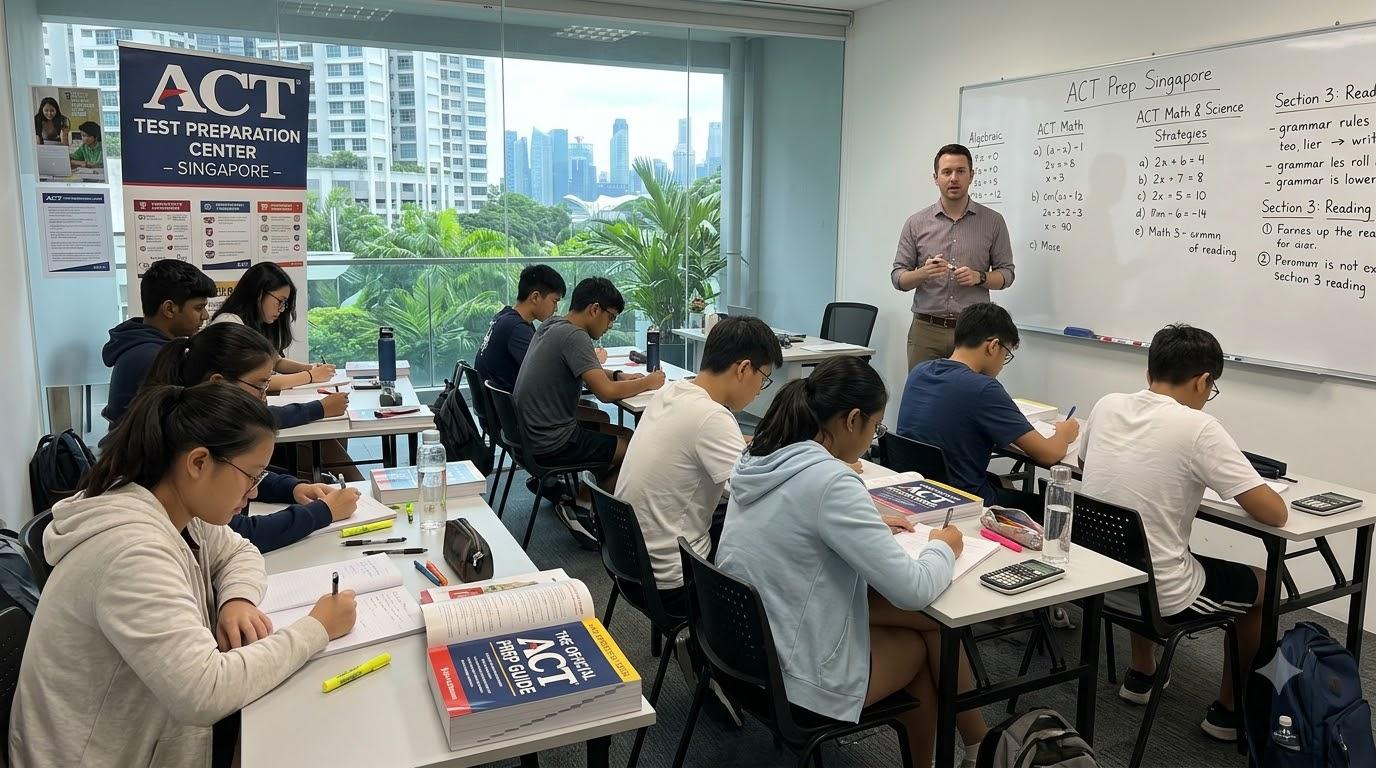
How to Prepare for the ACT Without Wasting Time on Ineffective Study Methods
Preparing for the ACT requires more than completing practice questions and memorising mathematical formulas. Students need to understand the current examination structure, identify their weakest skills, develop appropriate pacing strategies and review mistakes systematically.
Students considering structured act test preparation for better exam readiness should begin with a diagnostic assessment rather than immediately enrolling in a general revision programme. A personalised preparation strategy helps students concentrate on the skills most likely to limit their performance.
Understand the Current ACT Format Before Preparing
The ACT is a standardised examination used in college admissions, particularly in the United States.
Its enhanced format includes required English, Mathematics and Reading sections, with Science and Writing available as optional sections for applicable testing arrangements.
The ACT Composite score is calculated from English, Mathematics and Reading scores under the enhanced model. Students who take Science receive a separate Science score, which does not contribute to the enhanced Composite score.
The updated structure gives students more time per question than the legacy examination.
According to ACT's official guidance, the current standard-time structure is:
|
Section |
Questions |
Time allowed |
Main focus |
|
English |
50 |
35 minutes |
Grammar, usage and rhetorical skills |
|
Mathematics |
45 |
50 minutes |
Mathematical reasoning |
|
Reading |
36 |
40 minutes |
Comprehension and analysis |
|
Science (optional) |
40 |
40 minutes |
Scientific data and reasoning |
|
Writing (optional) |
1 essay |
40 minutes |
Argument development |
The three required sections total 125 minutes of testing, excluding breaks and administrative time. <Cite refs={["turn134310search1","turn134310search58"]}/>
Students taking the examination internationally should confirm the format, available options and registration arrangements applicable to their test centre.
Why Students Underperform Despite Studying Hard
A student can spend several months preparing and still struggle on examination day.
This usually happens when preparation activities do not address the student's actual weaknesses.
For example, someone who repeatedly makes grammar mistakes may spend too much time revising mathematics because it feels more comfortable.
Another student may understand reading passages but consistently run out of time.
A third may know the mathematical concepts but misinterpret what questions require.
These difficulties demand different solutions.
A useful preparation plan begins by distinguishing between four broad categories:
-
Knowledge gaps.
-
Question interpretation errors.
-
Time-management problems.
-
Careless or procedural mistakes.
Without this diagnosis, students may complete large numbers of questions while repeating the same errors.
Take a Diagnostic Practice Examination First
The first step should be a realistic assessment of current performance.
Use practice material aligned with the enhanced examination rather than relying exclusively on older test formats.
Complete the relevant sections under appropriate time conditions.
Afterwards, review the results by skill category.
A total score is useful, but it does not explain why performance is weak.
For example, a student may receive a disappointing Mathematics result because of difficulties with geometry rather than algebra.
Another may lose marks because of timing despite having a good understanding of the underlying material.
What to Record After the Diagnostic
For every section, note:
-
The question types answered incorrectly.
-
The topics involved.
-
Whether the mistake came from misunderstanding or carelessness.
-
Whether time pressure affected the answer.
-
Which errors appear repeatedly.
Use this information to establish revision priorities.
Students should also consider their target institutions' current testing policies before deciding how much preparation is appropriate.
Build a Preparation Plan Around Your Weakest Skills
A common mistake is dividing study time equally between all subjects.
Equal time is not always effective.
Suppose a student performs strongly in English and Reading but struggles with mathematical reasoning.
Spending one-third of preparation time on each section may not be the best strategy.
A more useful plan allocates additional attention to Mathematics while maintaining regular practice in stronger areas.
However, students should avoid ignoring a section entirely.
Skills can deteriorate when they are not revisited.
Compare Different Preparation Approaches
|
Preparation method |
Best for |
Potential limitation |
|
Independent study |
Motivated students with clear weaknesses |
Requires self-discipline |
|
Official practice questions |
Understanding examination style |
Limited value without detailed review |
|
Group classes |
Structured instruction and shared practice |
May not address individual weaknesses |
|
One-to-one tutoring |
Specific skill gaps and personalised feedback |
Requires time and financial commitment |
|
Timed mock examinations |
Pacing and examination familiarity |
Inefficient if errors are not reviewed |
|
Error logs |
Identifying recurring mistakes |
Must be updated consistently |
Students should select a combination that matches their current performance and available resources.
Improve English Scores Through Rule-Based Practice
The English section assesses students' ability to revise and edit written passages.
Questions may involve grammar, punctuation, sentence structure, organisation and effective expression.
Students often approach these questions by choosing the option that sounds most natural.
Although language intuition can sometimes help, it is not always reliable.
A better approach is to understand the underlying writing conventions.
Focus on High-Value Grammar Skills
Important areas include:
-
Subject–verb agreement.
-
Verb tense consistency.
-
Pronoun reference.
-
Sentence boundaries.
-
Punctuation.
-
Modifiers.
-
Concision.
-
Logical transitions.
For example, consider:
"The collection of scientific reports are available online."
The subject is "collection," which is singular.
Therefore, the correct verb is "is."
The phrase "of scientific reports" does not change the grammatical number of the subject.
Understanding this principle helps students solve unfamiliar examples rather than memorising individual sentences.
Practise Rhetorical Questions Separately
Not every English question is about grammar.
Some ask students to improve clarity, organisation or the effectiveness of a paragraph.
Students should consider the writer's purpose and the surrounding context.
An option may be grammatically correct but inappropriate because it introduces irrelevant information or weakens the argument.
Strengthen Mathematics Through Concept Recognition
Mathematics preparation should combine content review with practice identifying the correct approach.
The examination assesses mathematical reasoning across several areas, including algebra, functions, geometry, statistics and probability.
Students sometimes lose time because they try to apply complicated calculations to questions that can be solved more efficiently.
Consider a simple linear equation:
3x+7=223x+7=223x+7=22
Subtracting 7 gives:
3x=153x=153x=15
Therefore:
x=5x=5x=5
This example is straightforward, but more difficult questions may present the same underlying relationship through a word problem or graph.
The key is recognising the mathematical structure.
Build a Mathematics Error Log
After each practice session, classify mistakes.
Was the problem caused by an unfamiliar concept?
Did the student misunderstand the question?
Was the algebra incorrect?
Was the calculator used inappropriately?
Did time pressure cause the mistake?
Each category requires a different response.
Students should also practise checking answers through substitution, estimation or alternative methods where appropriate.
Improve Reading Speed Without Sacrificing Understanding
Reading is often challenging because students must interpret unfamiliar passages under time constraints.
Some students read every sentence carefully but struggle to finish.
Others skim so aggressively that they miss important details.
Neither extreme is consistently effective.
A better strategy involves reading with a clear purpose.
Students should identify the passage's central argument, structure and important relationships.
When answering questions, they should distinguish between what the passage explicitly states and what can reasonably be inferred.
Use Evidence to Eliminate Wrong Answers
Incorrect options may:
-
Contradict the passage.
-
Exaggerate a claim.
-
Introduce unsupported information.
-
Confuse a minor detail with the main idea.
-
Describe a plausible idea that the author does not establish.
Students should practise locating evidence before selecting an answer.
This is particularly useful when two options appear similar.
Should You Take the Optional Science Section?
The enhanced ACT allows Science to be optional in applicable administrations.
However, students should not decide solely because the section is no longer part of the Composite score.
They should investigate the admissions policies of their intended institutions.
Science may be useful for students who want to demonstrate scientific reasoning, particularly when applying to programmes where such skills are relevant.
The section focuses on interpreting data, understanding investigations and evaluating scientific information.
It does not function simply as a memorisation examination covering every topic in Biology, Chemistry and Physics.
Students should practise reading graphs, comparing experimental results and identifying conclusions supported by evidence.
For international candidates, ACT's published enhancement timeline identifies February 2026 as the introduction of enhanced test content. <Cite ref="turn134310search12"/>
A Six-Step ACT Preparation Strategy
Step 1: Establish Your Target
Research the testing policies and score expectations of your intended universities.
Do not assume every institution requires scores or treats them identically.
Step 2: Complete a Diagnostic
Use current-format practice material.
Record section performance, timing and recurring mistakes.
Step 3: Prioritise Weak Skills
Choose a small number of improvement objectives.
For example, focus on punctuation, algebraic functions and evidence-based reading questions.
Step 4: Practise With Feedback
Complete targeted questions and review every incorrect answer.
Explain why the correct option is supported and why the alternatives are wrong.
Step 5: Introduce Timed Practice
Begin with short timed sets before progressing to full-length practice.
Develop pacing habits that allow enough time for later questions.
Step 6: Review and Adjust
Compare performance across practice sessions.
If a strategy is not improving accuracy or timing, investigate the reason and modify it.
Students preparing for the act test should treat this process as an ongoing cycle rather than a fixed checklist completed only once.
Practical Example 1: A Student Who Runs Out of Reading Time
Imagine a student who performs well on untimed Reading questions but regularly leaves several questions unanswered during timed practice.
The student assumes that reading faster is the only solution.
However, reviewing the practice reveals that too much time is spent reconsidering answers already supported by the passage.
The student introduces a new routine.
First, they identify the main purpose and structure of each passage.
Next, they locate evidence for each question.
When an answer is sufficiently supported, they move forward rather than repeatedly restarting the analysis.
They also practise making a reasoned selection when time is running short.
The objective is to improve time allocation without sacrificing accuracy unnecessarily.
Practical Example 2: A Student With Repeated Mathematics Errors
Another student understands algebra but frequently loses marks on word problems.
The student begins by highlighting the quantities and relationships described in each question.
Before calculating, they write a mathematical expression representing the situation.
For example, if a service charges a fixed fee plus an hourly rate, the total cost can be represented as:
C=f+rhC=f+rhC=f+rh
Here, fff represents the fixed fee, rrr the hourly rate and hhh the number of hours.
By practising the translation from words into equations, the student addresses the underlying difficulty.
This is more useful than repeatedly solving familiar algebraic expressions without context.
Illustrative Case Study: Improving Preparation Efficiency
Consider a hypothetical student named Ethan.
Ethan plans to apply to universities in the United States and has eight weeks available for examination preparation.
His initial approach involves completing random online questions every evening.
Although he studies regularly, he cannot explain which skills are improving.
A diagnostic assessment reveals strong English performance, inconsistent Mathematics results and timing difficulties in Reading.
His plan is reorganised.
During the first two weeks, Ethan reviews algebra and functions while maintaining shorter English practice sessions.
During weeks three and four, he introduces timed Reading sets and analyses questions that consume excessive time.
During weeks five and six, he completes mixed practice and revisits recurring Mathematics errors.
During the final two weeks, he uses full-length practice examinations to assess pacing and readiness.
The expected result is a clearer understanding of his strengths, more efficient preparation and fewer repeated mistakes.
No particular score increase is guaranteed.
The case demonstrates why targeted preparation is generally more useful than unstructured repetition.
When Professional Test Preparation Can Help
Some students can prepare effectively through independent study and official materials.
Others benefit from external structure, particularly when they struggle to identify weaknesses or maintain a consistent routine.
The Princeton Review Singapore provides information about test preparation and admission-related services.
Before choosing a course, students should ask how instruction is adapted to their diagnostic results.
Useful questions include whether lessons use the current examination format, how progress is measured and whether feedback explains the reasons behind incorrect answers.
Students considering additional preparation for the act test should also compare the time commitment with their school workload and application deadlines.
A programme should strengthen independent performance rather than encourage dependence on guided solutions.
Avoid Common Test Preparation Mistakes
Using Outdated Practice Material Without Checking the Format
Older materials can still help students practise underlying academic skills.
However, they may not reflect current question counts, timing or scoring arrangements.
Use updated official information when planning realistic mock examinations.
Completing Tests Without Reviewing Mistakes
A practice examination is most valuable when it reveals specific weaknesses.
Students should spend meaningful time analysing incorrect answers.
Studying Only Comfortable Subjects
Repeatedly practising strong areas can create confidence without addressing the main obstacles to improvement.
Changing Strategies Too Frequently
Students need enough practice to evaluate whether a technique works.
Constantly switching methods makes progress difficult to measure.
Ignoring Examination Conditions
Practising exclusively without time limits can create unrealistic expectations.
Students should gradually introduce the conditions they expect on examination day.
Assuming a High Score Guarantees Admission
College admissions decisions may consider academic performance, extracurricular activities, essays, recommendations and other factors.
Testing policies differ between institutions.
A strong score can support an application where relevant, but it does not guarantee acceptance.
Prepare for Examination Day
Preparation should include practical arrangements as well as academic revision.
Students should confirm their registration, test location, identification requirements and reporting instructions.
They should also review permitted calculator policies and the rules applicable to their testing format.
The official ACT test-day guidance explains identification, prohibited items and examination procedures. <Cite ref="turn134310search3"/>
Avoid leaving administrative checks until the morning of the examination.
In the final days, prioritise manageable review, sleep and familiarity with procedures rather than attempting to learn every remaining topic.
How to Measure Progress Accurately
Improvement should be evaluated through more than one practice score.
Students should track accuracy by question category, completion rates and the frequency of recurring errors.
For example, a higher Mathematics score is encouraging, but it is also useful to know whether improvement came from better algebra skills or fewer careless mistakes.
Likewise, faster Reading performance is meaningful only if comprehension remains sufficiently accurate.
Use multiple practice sessions to identify patterns.
A single unusually strong or weak result should not automatically determine the next preparation strategy.
When preparing for the act test, consistent performance across different question sets is a more useful indicator than confidence based on familiar exercises.
Conclusion
Effective ACT preparation begins with understanding the current examination format and identifying individual weaknesses.
Students should combine targeted content review, question analysis, timed practice and regular progress checks.
Whether studying independently or using a structured preparation programme, the objective is to improve accuracy, reasoning and time management.
The best next step is to complete a current-format diagnostic assessment and create a realistic study plan based on the results.
Frequently Asked Questions
How long should I prepare for the ACT?
Preparation time depends on existing skills, target scores, school commitments and available study hours. Begin with a diagnostic assessment to determine the amount of work required.
Is the ACT Science section compulsory?
Under the enhanced format, Science is optional in applicable testing arrangements. Students should confirm their test options and check the policies of their intended universities.
What is the maximum ACT Composite score?
The ACT Composite score uses a scale from 1 to 36. Under the enhanced format, the Composite is based on English, Mathematics and Reading.
Should I take both the SAT and ACT?
Not necessarily. Students should compare the examinations, consider their strengths and review university requirements before deciding whether taking both offers a meaningful benefit.
How can I improve my ACT Reading timing?
Practise identifying passage structure, locating supporting evidence and eliminating unsupported options. Use timed question sets and review where excessive time is being spent.
Are practice tests enough to prepare successfully?
Practice tests are useful, but they should be combined with targeted revision and detailed error analysis. Repeating examinations without correcting weaknesses may produce limited improvement.


 Arabic
 French
 Spanish
 Portuguese
 Deutsch
 Turkish
 Dutch
 Italiano
 Russian
 Romaian
 Portuguese (Brazil)
 Greek