


Water Chillers Market Industry Outlook 2026–2036
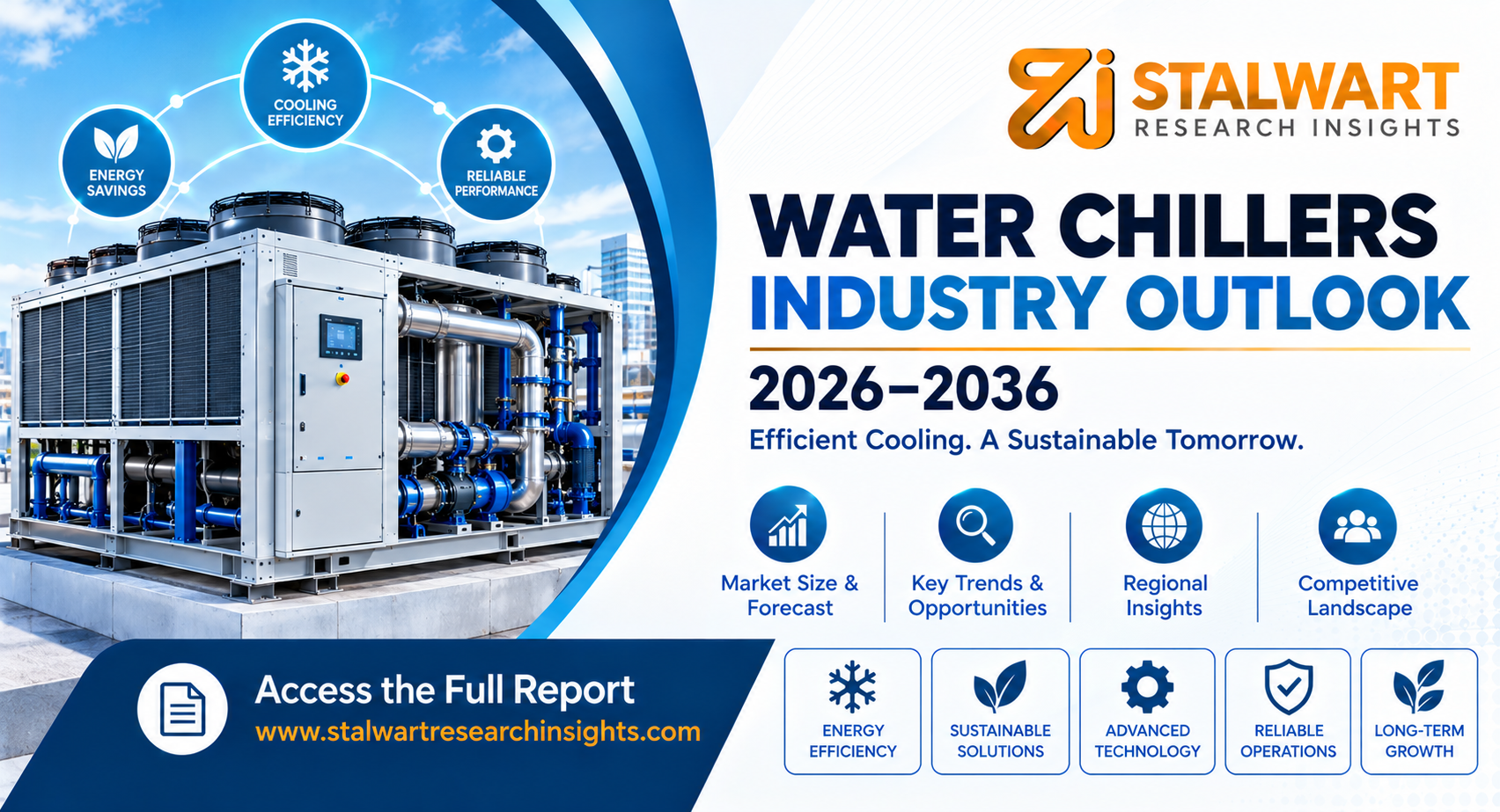
Overview of the Market:
The global water chillers market comprises cooling systems that remove heat from water or other circulating fluids for commercial air conditioning and industrial process cooling. These systems are widely used in office buildings, hospitals, hotels, manufacturing plants, pharmaceutical facilities, food processing operations, and data centers. Increasing urbanization, expansion of commercial infrastructure, and rising demand for reliable temperature control are supporting market growth. Manufacturers are developing energy-efficient chillers featuring variable-speed compressors, intelligent controls, improved heat exchangers, and lower-global-warming-potential refrigerants. Growing interest in digital monitoring and predictive maintenance is also helping facility operators improve equipment performance and reduce downtime. However, high installation costs, energy consumption, maintenance requirements, and water availability constraints for some water-cooled systems remain important considerations. Continued investment in industrial cooling, building modernization, and data center infrastructure is expected to create opportunities for the market through 2036.
Industry Insights: Scale, Segments, and Shifts
Market Size & Growth: The global water chillers market is projected to reach USD 20.0 billion by 2036, registering a CAGR of 4.9% between 2026 and 2036
Access the full report PDF here:
https://www.stalwartresearchinsights.com/request-sample/water-chillers-industry-outlook-2026-2036
Key Market Trends
-
Increasing demand for energy-efficient water chillers in commercial and industrial facilities.
-
Growing adoption of screw, scroll, and centrifugal chiller technologies.
-
Rising demand for precision cooling in data centers and other mission-critical facilities.
-
Greater use of variable-speed compressors and intelligent control systems.
-
Increasing adoption of low-global-warming-potential refrigerants.
-
Growing integration of IoT-enabled monitoring and predictive maintenance.
-
Expansion of industrial process cooling in pharmaceuticals, chemicals, plastics, and food processing.
-
Rising focus on lifecycle energy savings, equipment reliability, and sustainable building operations.
Analytical Tool
-
SWOT Analysis: Evaluates market strengths, weaknesses, opportunities, and threats.
-
PESTEL Analysis: Examines political, economic, social, technological, environmental, and legal influences.
-
Porter's Five Forces: Assesses competitive rivalry, supplier power, buyer power, substitutes, and barriers to entry.
-
Market Segmentation Analysis: Studies chiller types, cooling capacity, applications, end-use industries, and regional demand.
-
Competitive Benchmarking: Compares manufacturers based on energy efficiency, product portfolios, technological innovation, and service capabilities.
-
Value Chain Analysis: Examines component sourcing, manufacturing, installation, maintenance, and aftermarket services.
Regional Analysis
-
North America: Supported by commercial building upgrades, industrial cooling requirements, data center expansion, and demand for energy-efficient HVAC systems.
-
Europe: Driven by energy efficiency standards, environmentally responsible refrigerants, industrial modernization, and sustainable building initiatives.
-
Asia-Pacific: Benefits from industrialization, urban development, manufacturing growth, and increasing investments in commercial infrastructure.
-
Latin America: Opportunities are supported by expanding food processing, manufacturing, healthcare infrastructure, and commercial construction.
-
Middle East and Africa: Demand is influenced by hot climatic conditions, large-scale commercial projects, district cooling infrastructure, and industrial development.
Asia-Pacific is a major regional market for chillers, supported by industrial growth and infrastructure investment.
SWOT Analysis
-
Strengths: Reliable temperature control, broad industrial applications, and effective cooling for large commercial facilities.
-
Weaknesses: High initial investment, installation complexity, and ongoing maintenance requirements.
-
Opportunities: Data center cooling, energy-efficient equipment upgrades, smart monitoring, and low-impact refrigerant technologies.
-
Threats: Refrigerant regulation changes, energy price fluctuations, water scarcity, and competition from alternative cooling technologies.
PESTEL Analysis
-
Political: Government policies supporting energy efficiency, industrial development, and sustainable infrastructure influence demand.
-
Economic: Construction investment, electricity costs, equipment prices, and industrial production affect purchasing decisions.
-
Social: Increasing expectations for indoor comfort, healthcare reliability, and temperature-controlled environments support adoption.
-
Technological: Variable-speed compressors, smart controls, advanced heat exchangers, and predictive maintenance improve performance.
-
Environmental: Refrigerant emissions, water consumption, energy efficiency, and equipment lifecycle impacts influence product development.
-
Legal: Refrigerant regulations, energy performance standards, safety requirements, and building codes affect manufacturing and installation.
Market Share
-
By Chiller Type: Screw chillers, scroll chillers, centrifugal chillers, reciprocating chillers, and absorption chillers.
-
By Cooling Capacity: Below 100 kW, 101–350 kW, 351–700 kW, and above 700 kW.
-
By Application: Commercial HVAC, industrial process cooling, data centers, and specialized cooling applications.
-
By End-Use Industry: Healthcare, pharmaceuticals, food and beverage, chemicals and petrochemicals, plastics and rubber, manufacturing, and commercial buildings.
-
By Technology: Conventional compression systems, absorption systems, and advanced high-efficiency cooling technologies.
-
By Region: North America, Europe, Asia-Pacific, Latin America, and the Middle East and Africa.
Key Players
-
Carrier Global Corporation
-
Trane Technologies
-
Daikin Industries
-
Johnson Controls
-
Mitsubishi Electric
-
LG Electronics
-
Blue Star Limited
-
Thermax Limited
-
Bosch
-
Dunham-Bush
-
Smardt Chiller Group
-
Midea Group
Challenges
-
High upfront costs for equipment installation and infrastructure.
-
Energy consumption and operating expenses over the equipment lifecycle.
-
Maintenance requirements for compressors, heat exchangers, and cooling systems.
-
Water treatment and cooling tower requirements for water-cooled installations.
-
Compliance with changing refrigerant and energy efficiency regulations.
-
Integration with existing building management and industrial control systems.
-
Shortage of specialized installation and maintenance expertise in some markets.
Future Opportunities
-
Expansion of cooling infrastructure for data centers and AI computing facilities.
-
Adoption of high-efficiency chillers with variable-speed and magnetic-bearing technologies.
-
Growing demand for low-global-warming-potential refrigerants.
-
Replacement of aging equipment with modern, energy-efficient systems.
-
Integration of AI-powered monitoring and predictive maintenance.
-
Increasing use of heat recovery and integrated heating and cooling systems.
Browse Trending Report:
- Battery Case Industry Outlook 2026–2036
- Automotive Lead Acid Battery Industry Outlook 2026–2036
- Air Suspension Industry Outlook
- Aircraft Interior Lighting Industry Outlook
- Aluminium Alloys Industry Outlook 2026–2036
- All-Terrain Vehicle Industry Outlook
Conclusion
The water chillers market is evolving as commercial and industrial users seek reliable, energy-efficient cooling solutions. Demand from data centers, healthcare facilities, manufacturing plants, and commercial buildings is encouraging manufacturers to develop advanced compressors, intelligent controls, and environmentally responsible refrigerant technologies.
Contact Us:
Stalwart Research Insights
Website: https://www.stalwartresearchinsights.com


 Arabic
 French
 Spanish
 Portuguese
 Deutsch
 Turkish
 Dutch
 Italiano
 Russian
 Romaian
 Portuguese (Brazil)
 Greek