


US High-Density Polyethylene Market 2026–2034: Uses & Firms
United States High-Density Polyethylene Market Size & Forecast 2026–2034
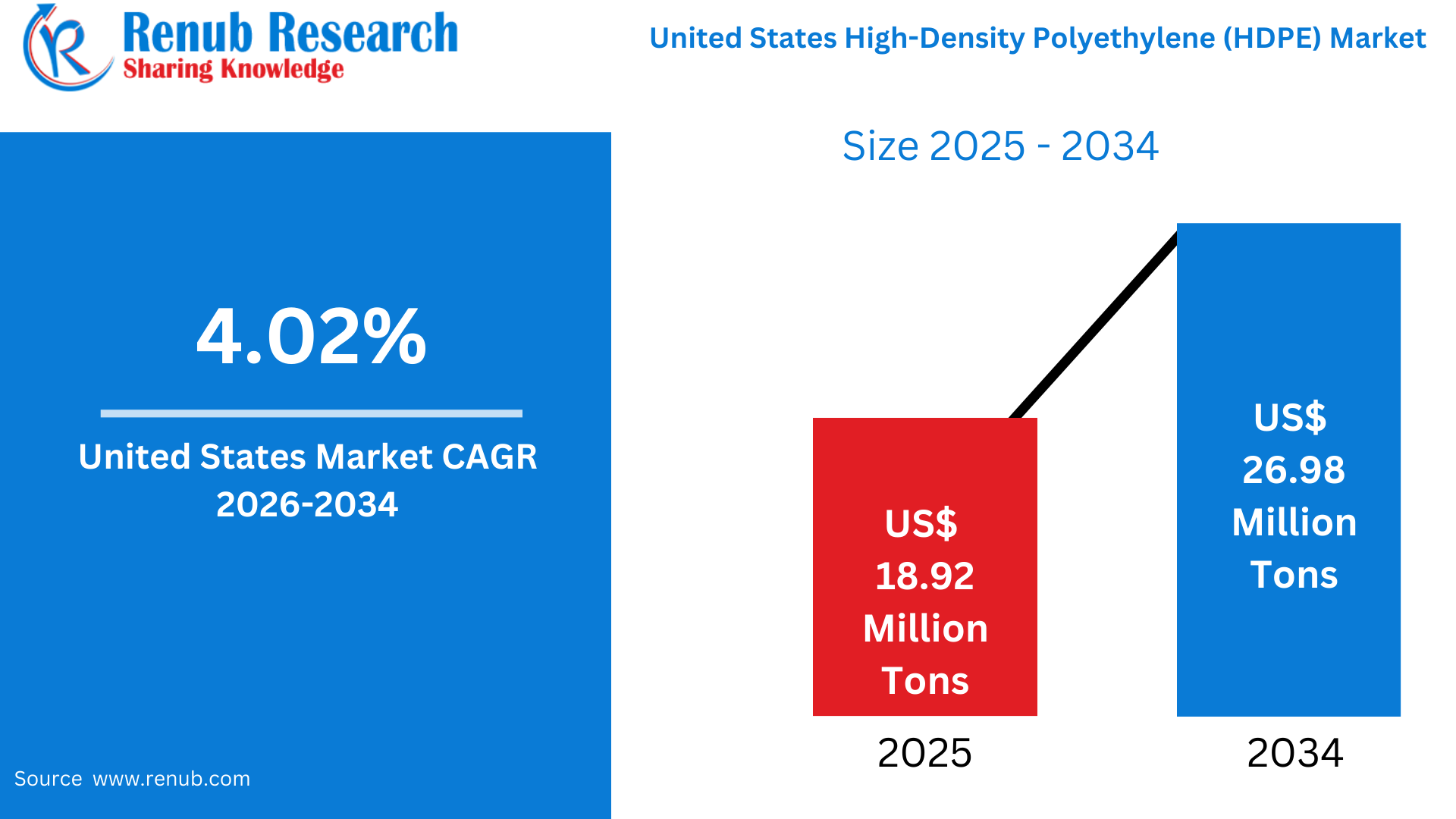
According To Renub Research United States High-Density Polyethylene (HDPE) market is projected to witness steady and sustainable growth over the forecast period from 2026 to 2034. In 2025, the market stood at approximately 18.92 million tons and is expected to reach nearly 26.98 million tons by 2034, expanding at a compound annual growth rate (CAGR) of 4.02%. This growth trajectory is driven by increasing demand from packaging, construction, automotive, and infrastructure sectors, along with the rising preference for lightweight, durable, and recyclable plastic materials. Advancements in recycling technologies and growing emphasis on sustainability further strengthen the long-term outlook of the HDPE market in the United States.
Download Free Sample Report:https://www.renub.com/request-sample-page.php?gturl=united-states-high-density-polyethylene-hdpe-market-p.php
United States High-Density Polyethylene Market Outlook
High-Density Polyethylene (HDPE) is a widely used thermoplastic polymer produced from petroleum-based feedstocks. It is valued for its high strength-to-density ratio, excellent chemical resistance, durability, and moisture resistance. HDPE is extensively used in the manufacturing of bottles, containers, caps, pipes, geomembranes, films, and various automotive and industrial components. Its lightweight nature, impact resistance, and thermal stability make it suitable for demanding applications across both consumer and industrial markets.
In the United States, HDPE demand is strongly influenced by the packaging, construction, and infrastructure sectors. Packaging applications benefit from HDPE’s food safety, durability, and cost efficiency, while construction applications rely on its corrosion resistance and long service life. Additionally, HDPE’s recyclability aligns well with evolving environmental regulations and sustainability goals. As industries seek materials that balance performance, cost, and environmental responsibility, HDPE continues to play a critical role in the U.S. plastics landscape.
Growth Drivers in the United States High-Density Polyethylene Market
Strong Demand from Packaging and Consumer Products
One of the primary drivers of the U.S. HDPE market is robust demand from the packaging and consumer goods industries. HDPE is widely used for bottles, containers, caps, and closures in food, beverages, household chemicals, and personal care products. Its strength, chemical resistance, and safety profile make it ideal for protecting contents while maintaining lightweight packaging solutions.
The rapid growth of packaged food consumption, e-commerce, and home delivery services has significantly increased the need for durable and lightweight packaging materials. HDPE helps manufacturers reduce transportation costs while ensuring product integrity. Moreover, its high recyclability supports corporate sustainability targets and compliance with environmental regulations, making it a preferred material for brand owners and packaging manufacturers.
Infrastructure Development and Construction Applications
Infrastructure modernization and construction activities are major contributors to HDPE consumption in the United States. HDPE pipes are extensively used for water supply, sewage systems, drainage networks, and gas distribution due to their flexibility, corrosion resistance, and long operational life. Compared to traditional materials such as metal or concrete, HDPE pipes offer lower installation and maintenance costs, making them highly attractive for large-scale infrastructure projects.
Government-led infrastructure investments further accelerate demand for HDPE piping systems. In addition, HDPE geomembranes are widely used in landfill liners, water containment systems, and environmental protection applications. These uses highlight HDPE’s role in supporting durable, cost-effective, and environmentally responsible infrastructure development across the country.
Recycling Advancements and Sustainability Initiatives
Sustainability is emerging as a powerful growth driver in the U.S. HDPE market. HDPE is one of the most widely recycled plastics, and the use of recycled HDPE (rHDPE) is steadily increasing across packaging, construction, and automotive sectors. Regulatory pressure to reduce plastic waste and promote circular economy practices is pushing manufacturers to incorporate recycled content into their products.
Advances in recycling technologies have made it possible to produce high-quality rHDPE suitable for demanding applications. Leading brands and manufacturers are committing to higher recycled content targets, driving consistent demand for recyclable and recycled HDPE. As sustainability becomes a core focus of material selection, HDPE’s recyclability positions it favorably in the evolving U.S. plastics market.
Challenges in the United States High-Density Polyethylene Market
Environmental Concerns and Regulatory Pressures
Despite its recyclability, HDPE faces challenges from growing environmental concerns related to plastic waste. Increasing scrutiny of single-use plastics and stricter environmental regulations may impact demand, particularly in packaging applications. Compliance with evolving regulations requires additional investments in sustainable production methods and recycling infrastructure, which can increase operational costs.
Public perception of plastics, even recyclable ones, can influence consumption patterns and policy decisions. Manufacturers must continuously innovate to demonstrate the environmental benefits of HDPE through recycling, reduced material usage, and life-cycle sustainability to maintain market growth.
Volatility in Raw Material Prices
Fluctuations in crude oil and natural gas prices pose a significant challenge to the U.S. HDPE market. HDPE production relies on petrochemical feedstocks, making it sensitive to changes in energy prices. Sudden increases in raw material costs can affect production margins and create pricing uncertainty for end users. Managing feedstock volatility remains a critical concern for HDPE producers and downstream manufacturers.
United States High-Density Naphtha Polyethylene Market
The high-density naphtha polyethylene segment represents a smaller but important portion of HDPE production in the United States. While ethane from shale gas dominates U.S. feedstocks, naphtha-based HDPE continues to serve specific applications requiring particular molecular structures and performance characteristics. Naphtha-based HDPE offers advantages such as improved stiffness, surface finish, and processability, making it suitable for industrial containers, specialty packaging, and select automotive components. This segment complements ethane-based production by meeting niche performance requirements within the broader HDPE market.
United States High-Density Blow Molding Polyethylene Market
The blow molding HDPE market is a key contributor to overall HDPE demand in the United States. Blow-molded HDPE is widely used to produce hollow products such as bottles, containers, drums, and jerry cans for food, beverages, personal care, household chemicals, and industrial fluids. HDPE’s impact resistance, chemical stability, and strength make it ideal for safely packaging liquids.
The growth of packaged goods, e-commerce, and home delivery services continues to fuel demand for blow-molded HDPE products. Additionally, the increasing use of recycled HDPE in blow molding applications reflects the industry’s commitment to sustainability. Lightweighting innovations and improved barrier properties further enhance the performance of blow-molded HDPE packaging.
United States High-Density Injection Molding Polyethylene Market
Injection molding is another critical processing method in the U.S. HDPE market. Injection-molded HDPE is used to manufacture caps, closures, crates, pallets, bins, housewares, and automotive components. This process allows for high precision, consistency, and efficient large-scale production of complex shapes.
HDPE’s toughness, chemical resistance, and recyclability make it suitable for reusable and long-life products. Demand for injection-molded HDPE is supported by growth in food packaging, logistics, agriculture, and industrial applications. As industries increasingly adopt reusable packaging and durable plastic solutions, injection molding remains an essential segment of the U.S. HDPE market.
United States High-Density Polyethylene Solution Process Market
The solution process segment focuses on producing specialized grades of HDPE with controlled molecular weight and uniform polymer structure. Solution-processed HDPE offers enhanced mechanical properties, stress crack resistance, and clarity, making it suitable for high-performance applications such as pressurized pipes, geomembranes, industrial films, and specialty packaging.
Although solution processing involves higher complexity and costs compared to other methods, it delivers consistent quality and superior performance characteristics. This makes it valuable for applications requiring high strength, stability, and reliability, supporting its continued presence in the U.S. HDPE market.
California High-Density Polyethylene Market
California represents a significant HDPE market due to strong demand from packaging, consumer goods, and construction sectors. The state’s large population and advanced economy generate substantial requirements for HDPE in food packaging, personal care products, and household items. Strict environmental regulations in California encourage the use of recyclable and post-consumer recycled HDPE, supporting sustainability-driven demand.
HDPE applications in pipelines, geomembranes, and utility fittings are also robust due to ongoing infrastructure development and the material’s durability and lightweight properties. California’s focus on sustainability positions HDPE as a key material for meeting both performance and environmental goals.
Texas High-Density Polyethylene Market
Texas is one of the largest HDPE markets in the United States, supported by its strong petrochemical industry and access to abundant feedstocks. Large-scale polymerization facilities and extensive downstream industries drive high HDPE production and consumption. Demand is fueled by packaging, industrial containers, automotive applications, and infrastructure projects.
Texas also benefits from its strategic role in logistics and exports, making it a major hub for HDPE manufacturing and distribution. The state’s industrial strength and infrastructure needs ensure sustained demand for HDPE across multiple applications.
New York High-Density Polyethylene Market
In New York, HDPE demand is driven by packaging requirements for consumer goods, personal care products, and food items. The state’s large population and urban environment support consistent consumption of lightweight and durable packaging materials. Infrastructure maintenance and development further contribute to HDPE usage in water and sewage systems.
Environmental initiatives promoting recycling and reuse of plastics enhance the adoption of recycled HDPE. The growth of retail and e-commerce activities also increases demand for robust packaging solutions, reinforcing HDPE’s importance in New York’s consumer-driven economy.
Washington High-Density Polyethylene Market
Washington’s HDPE market is shaped by strong environmental awareness and advanced recycling initiatives. HDPE is widely used in packaging, construction, and infrastructure due to its recyclability and long service life. Water resource management and environmental protection projects drive demand for HDPE pipes and geomembranes.
Urban development around major cities supports growth in construction-related HDPE applications. With a strong emphasis on sustainability and recycling, Washington represents a stable and environmentally driven HDPE market within the United States.
Market Segmentation Overview
The United States High-Density Polyethylene market is segmented by feedstock, application, manufacturing process, and geography. Feedstocks include naphtha, natural gas, and other sources. Applications span blow molding, film and sheet, injection molding, pipe and extrusion, and other uses. Manufacturing processes include gas phase, slurry, and solution processes. Geographically, the market covers major states such as California, Texas, New York, Florida, Illinois, Washington, and others, reflecting diverse industrial and consumer demand patterns.
Competitive Landscape of the United States High-Density Polyethylene Market
The U.S. HDPE market is highly competitive, with major players focusing on capacity expansion, sustainability initiatives, and advanced processing technologies. Key companies operating in the market include The Dow Chemical Company, Exxon Mobil Corporation, LyondellBasell Industries N.V., INEOS AG, Formosa Plastics Corporation, Braskem SA, and Mitsui Chemicals Inc.. These companies compete through product innovation, efficient feedstock utilization, recycling advancements, and strategic investments to strengthen their positions in the evolving U.S. HDPE market.


 Arabic
 French
 Spanish
 Portuguese
 Deutsch
 Turkish
 Dutch
Dutch
 Italiano
 Russian
 Romaian
 Portuguese (Brazil)
 Greek
Greek