


We strictly adhere to all applicable government regulations, industry standards, and statutory compliance requirements.
STOK Strong Beer India: Why Demand Is Rising Fast
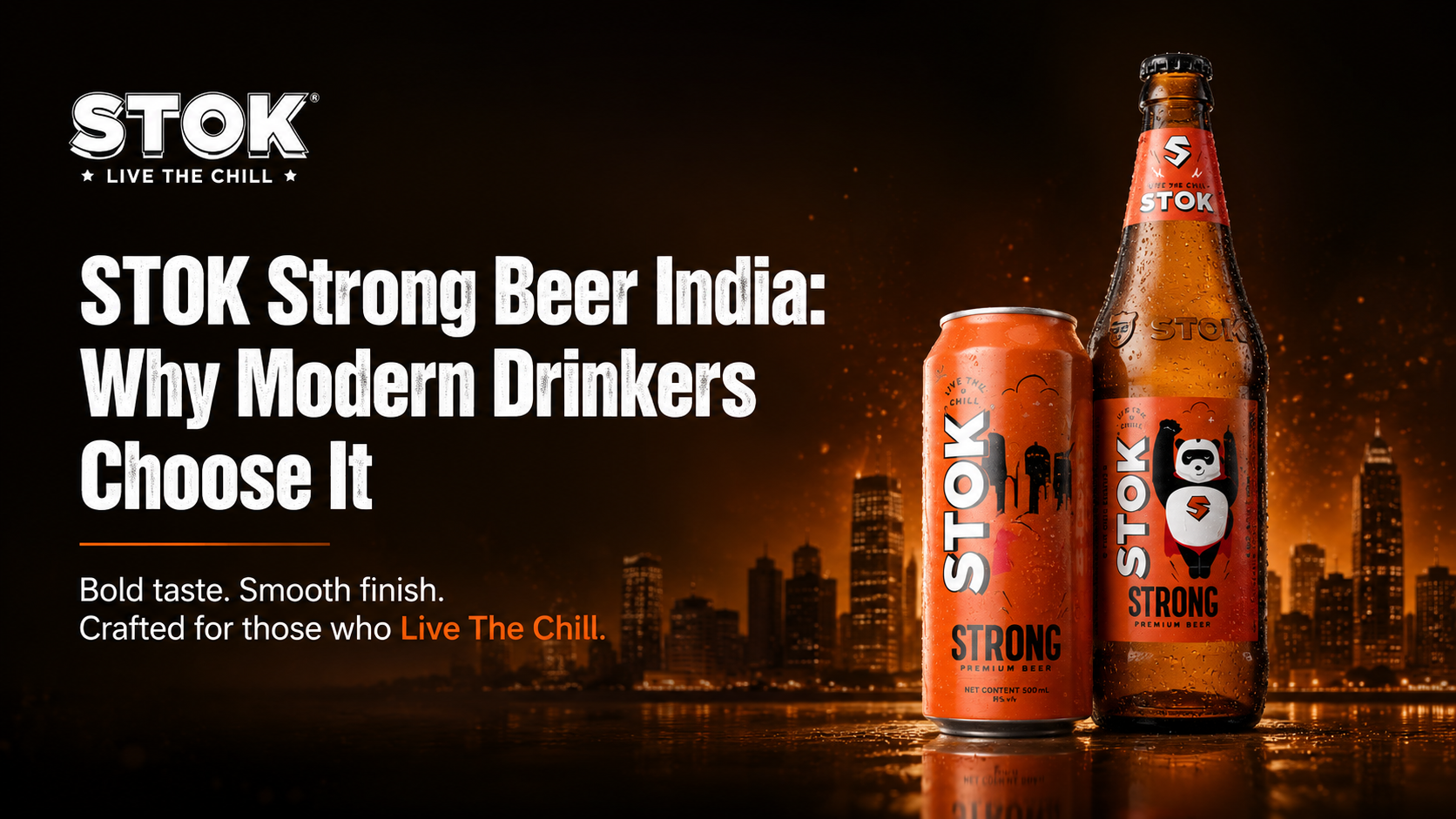
India's beer market crossed ₹45,000 crore in retail value in 2023, with strong beer accounting for over 70% of total beer volumes sold The shift toward premium strong beer is no longer a metro trend it is reshaping purchasing behaviour across Tier 1 and Tier 2 cities. This post breaks down what is driving the STOK strong beer India growth story, what the data says about Indian drinkers' preferences, and where the premium strong beer segment is headed.
Why Is Strong Beer More Popular Than Mild Beer in India?
Strong beer outsells mild beer in India because it delivers higher alcohol by volume at a comparable price point. Indian consumers, particularly in the 21–35 age group, consistently prefer value-for-money drinking experiences. A strong beer typically carries an ABV of 6–9%, versus 4–5% in regular lager variants.
Price sensitivity plays a central role here. India's excise tax structure means that strong and mild beers often sit in the same retail price bracket at the state level. This gives strong beer an inherent value advantage. A consumer paying the same price for two products will naturally gravitate toward the one with a higher perceived yield.
Retail availability reinforces this further. Strong beer SKUs dominate shelf space in most licensed outlets across Maharashtra, Telangana, Karnataka, and Uttar Pradesh the four largest beer-consuming states by volume.
How ABV Shapes Consumer Choice in India
ABV is the single biggest purchase driver for Indian beer drinkers below the premium tier. Multiple consumer surveys show that drinkers cite "strength" before taste or brand when selecting a beer at retail. This makes high-ABV positioning a commercial necessity, not just a product attribute.
Urban vs Semi-Urban Consumption Patterns
Urban metros are showing a bifurcation. While craft and imported mild beers are growing in premium on-trade channels, off-trade retail in semi-urban markets continues to run almost entirely on strong beer SKUs. The semi-urban consumer base is growing faster in raw volume terms than metro demand.
What Is Driving the Demand for Premium Strong Beer in India?
The premium strong beer segment is growing because Indian consumers are trading up within the strong beer category itself. They are not switching to mild beer they are spending more for better-quality strong beer. This is a structural shift, not a temporary trend.
Three forces are converging. First, disposable incomes in the 25–40 demographic have grown steadily. Second, media exposure to global beer culture has raised quality expectations even in mid-market segments. Third, brands that invest in packaging and taste credentials are capturing consumers who previously bought on price alone.
The accessible deep-dive into this product segment at this strong beer product page illustrates how brand positioning within the premium strong beer tier is evolving to meet these changing expectations.
The Role of Packaging and Brand Perception
Premium strong beer brands that invest in modern packaging are seeing faster volume growth than value-tier competitors. Packaging signals quality before the consumer even reads the label. In the Indian retail context, where shelf space is contested and visibility is everything, bottle design functions as silent salesmanship.
Income Growth and Premiumisation in Tier 2 Cities
Beer premiumisation is no longer a metro-exclusive phenomenon. Cities like Indore, Lucknow, Coimbatore, and Surat are reporting double-digit year-on-year growth in premium beer sales through organised retail channels. The aspirational consumer in these markets has the income to trade up and the intent to do so.
How Is the Indian Beer Market Changing in 2024?
India's beer market is consolidating around two poles: value strong beer and premium strong beer. The middle tier standard mild lager is shrinking. Consumers are either staying price-conscious and buying strong beer for value, or spending more for premium strong variants. This polarisation defines the market in 2024.
Total beer volumes in India are projected to grow at a CAGR of 8.1% between 2023 and 2027. The premium segment is expected to outpace this average, driven by younger urban consumers and expanding organised retail infrastructure.
Regulatory Changes Shaping Beer Availability
State-level excise policy changes in Maharashtra, Telangana, and Delhi have progressively made beer more accessible through supermarkets, convenience stores, and standalone beer shops. Each policy liberalisation correlates with a measurable uptick in beer volumes. Greater accessibility directly benefits premium strong beer brands, which are better positioned for modern retail environments.
On-Trade Recovery and Its Effect on Premium Beer
Post-pandemic recovery in bars, restaurants, and hotels has pushed draft beer consumption back toward pre-2020 levels. Premium strong beer brands have benefited disproportionately in the on-trade channel, where consumers are willing to pay more per unit in a social setting.
What Is the Difference Between Strong Beer and Regular Beer in India?
Strong beer in India refers to any beer with an ABV above 5%, though most commercially available strong beers sit between 6.5% and 8.5%. Regular or mild beer typically falls between 4% and 5% ABV. The legal and commercial categorisation of "strong beer" in India is set by state excise departments, and definitions vary slightly by state.
Beyond ABV, the flavour profile of strong Indian lagers tends to be bolder, with more malt-forward character. Brewers balance higher alcohol with bitterness to prevent the product from tasting flat or overly sweet.
Labelling and Regulatory Compliance
All beer sold in India must display ABV prominently on the label, per FSSAI regulations. Strong beer labels must additionally carry statutory health warnings. These requirements standardise consumer information and protect against misrepresentation of product strength.
Conclusion
The demand for STOK strong beer India reflects a broader market reality: Indian consumers are choosing stronger, better-quality beer in growing numbers. Premiumisation within the strong beer category is real, measurable, and accelerating across both urban and semi-urban markets. As disposable incomes rise and retail access expands, the strong beer segment will continue to outpace overall beer market growth. The question is not whether premium strong beer will grow in India it is which brands will have the positioning and distribution to capture that growth.
Patrocinados


 English
 Arabic
 French
 Portuguese
 Deutsch
 Turkish
 Dutch
Dutch
 Italiano
 Russian
 Romaian
 Portuguese (Brazil)
 Greek
Greek