


Top Revenue Cycle Management Strategies for Healthcare Practices
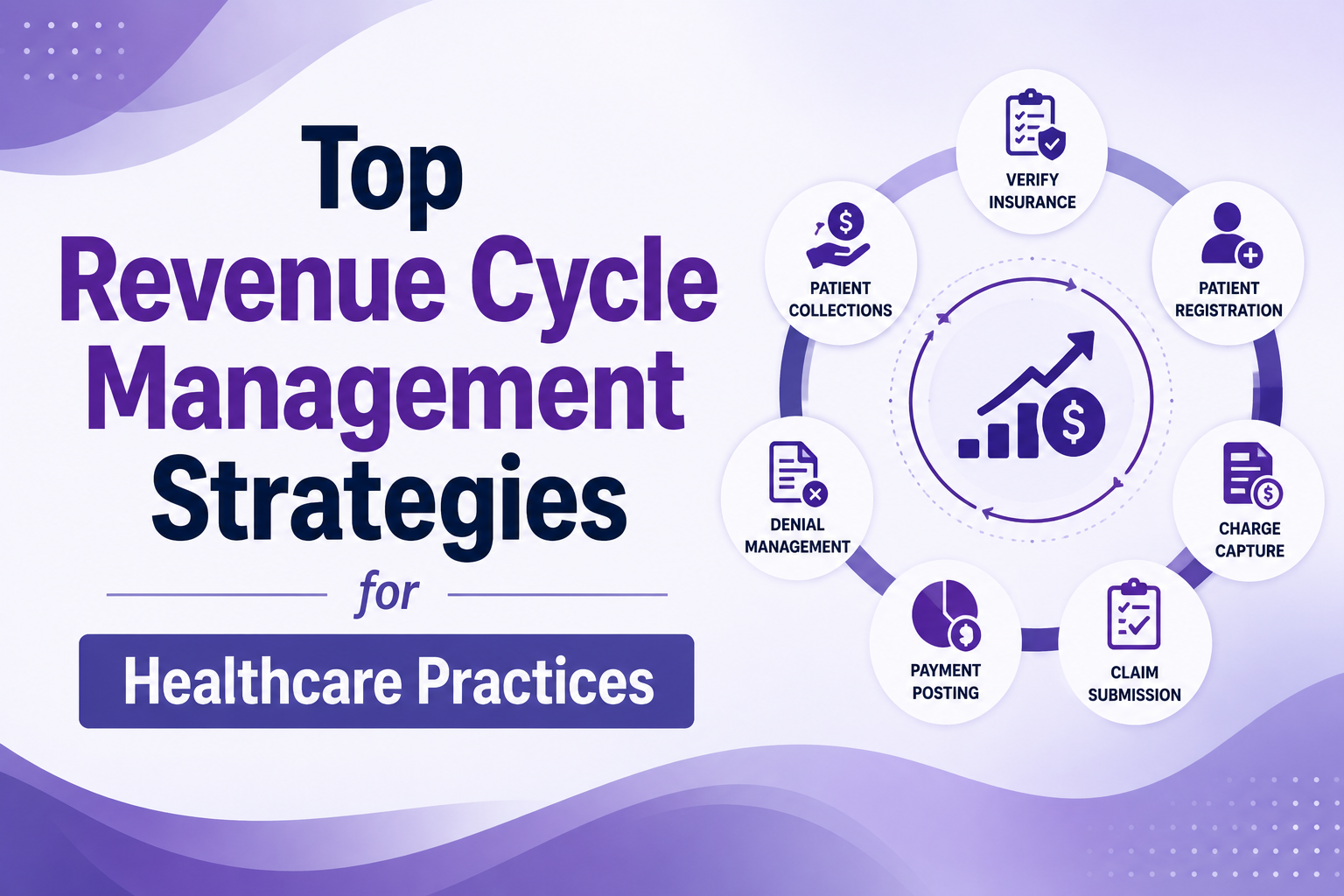
Top Revenue Cycle Management Strategies for Healthcare Practices
Every healthcare practice, regardless of specialty or size, depends on one financial process to keep its doors open: revenue cycle management. It's the engine that converts patient care into actual, collected revenue and when that engine runs smoothly, practices thrive. When it doesn't, even clinically excellent providers can find themselves buried in denials, delayed payments, and cash flow problems that threaten the long-term viability of the practice.
The good news is that revenue cycle performance isn't left to chance. There are proven, repeatable strategies that high-performing practices use to keep their revenue cycle efficient, accurate, and fast. Whether you're running a solo practice or managing a multi-provider group, the strategies below represent the most effective ways to strengthen your financial performance. Many practices find that implementing these strategies is far easier with the support of experienced medical billing services in New Jersey that already have the systems and expertise in place.
1. Start the Revenue Cycle Before the Patient Walks In
One of the biggest mistakes practices make is treating revenue cycle management as something that begins after a service is rendered. In reality, the most effective revenue cycle strategies start well before the patient arrives for their appointment.
Verify Insurance Eligibility in Advance Confirm active coverage, deductible status, co-pay amounts, and any prior authorization requirements before the appointment, not at check-in. This single step prevents a significant share of downstream denials.
Collect Accurate Demographic and Insurance Information Errors in a patient's name, date of birth, or insurance ID number are among the most common and most avoidable causes of claim rejections. A thorough intake process, ideally supported by digital forms and automated data validation, eliminates this category of errors almost entirely.
Confirm Prior Authorization Requirements Early For services that require prior authorization, initiate the request as soon as the appointment or procedure is scheduled. Waiting until the day of service creates unnecessary risk of delays or denials.
2. Standardize and Audit Coding Practices
Accurate coding is the backbone of a healthy revenue cycle. Even small, recurring coding errors compound into significant revenue loss over time.
Invest in Certified Coders Coders with credentials such as CPC or CCS bring a depth of knowledge that reduces error rates and keeps practices current with annual code set updates.
Conduct Regular Coding Audits Periodic internal or third-party audits of coded claims help identify patterns of undercoding, overcoding, or missed add-on codes before they become systemic problems.
Stay Current on Payer-Specific Coding Rules Many payers apply their own interpretations of coding guidelines, particularly around modifier usage and bundling rules. Keeping coders updated on payer-specific nuances reduces denial risk significantly.
3. Implement Pre-Submission Claim Scrubbing
One of the highest-leverage strategies in revenue cycle management is catching errors before a claim ever reaches the payer. Claim scrubbing software automatically checks claims against thousands of payer-specific rules, flagging issues like mismatched diagnosis and procedure codes, missing modifiers, or incomplete patient information.
Practices that implement rigorous claim scrubbing routinely see clean claim rates climb from the industry average of 75-80% to 95% or higher. That improvement alone dramatically reduces the administrative burden of reworking denied claims and accelerates overall payment timelines.
4. Build a Proactive Denial Management Process
Denials are inevitable, even in the best-run practices. What separates high-performing revenue cycles from struggling ones is how denials are handled once they occur.
Categorize Every Denial by Root Cause Tracking denials by reason code reveals patterns whether it's a specific payer, a specific service line, or a specific documentation gap driving the majority of denials.
Respond Quickly The longer a denial sits unaddressed, the harder it becomes to recover. Establish clear internal timelines for reviewing and resolving denials, ideally within days rather than weeks.
Appeal When Warranted A substantial majority of appealed denials are ultimately overturned when supported by proper documentation. Practices that have a formal appeals process in place recover meaningfully more revenue than those that simply write off denials as a loss.
Feed Denial Data Back Into Front-End Processes The most mature revenue cycle operations use denial data to improve eligibility verification, coding accuracy, and authorization workflows closing the loop so the same denial doesn't keep recurring.
5. Optimize Patient Collections
With the continued rise of high-deductible health plans, patient responsibility now makes up a growing share of practice revenue. Strategies that improve patient collections are an increasingly important part of overall revenue cycle performance.
Collect at the Point of Service Co-pays and known deductible amounts should be collected at check-in whenever possible, rather than billed after the fact. Collection rates drop substantially once a balance moves to post-visit billing.
Offer Clear, Convenient Payment Options Online payment portals, text-to-pay options, and flexible payment plans make it easier for patients to pay promptly, improving overall collection rates.
Provide Transparent Cost Estimates When patients understand their expected financial responsibility before or at the time of service, they're more likely to pay promptly and less likely to dispute charges later.
6. Track the Right Performance Metrics
You can't improve what you don't measure. High-performing practices track a consistent set of key performance indicators (KPIs) to monitor revenue cycle health:
-
Clean Claim Rate The percentage of claims accepted and paid on first submission
-
Days in Accounts Receivable (A/R) The average time between service delivery and payment collection
-
Denial Rate The percentage of claims denied, broken down by reason and payer
-
Net Collection Rate The percentage of allowed reimbursement actually collected
-
First-Pass Resolution Rate How many claims are resolved without requiring rework or appeal
Reviewing these metrics monthly and comparing them against industry benchmarks gives practice leadership the visibility needed to identify problems early and measure the impact of process improvements over time.
7. Leverage Technology and Automation
Manual revenue cycle processes simply can't keep pace with the volume and complexity of modern claims. Practices that invest in the right technology consistently outperform those relying on manual workflows.
Integrated Practice Management and EHR Systems When clinical documentation flows directly into billing without manual re-entry, transcription errors drop and charge capture improves.
Automated Eligibility and Authorization Tools Real-time verification tools reduce the administrative burden of manual eligibility checks while catching coverage issues before they become denials.
AI-Assisted Denial Prediction Newer billing platforms use historical claims data to flag claims at high risk of denial before submission, allowing staff to correct issues proactively rather than reactively.
8. Consider Specialty-Specific Revenue Cycle Expertise
Revenue cycle strategies that work well for a general primary care practice may fall short for specialties with unique billing requirements. Procedure-heavy specialties, behavioral health practices, and ancillary service providers each face distinct coding rules, authorization requirements, and payer behaviors that demand tailored expertise.
For practices in more complex specialties, partnering with a billing team experienced in specialty medical billing often yields better results than applying generic revenue cycle strategies across the board. The nuances of procedure coding, modifier usage, and payer-specific documentation requirements vary enough between specialties that a one-size-fits-all approach frequently leaves revenue on the table.
9. Build a Culture of Continuous Improvement
The most successful revenue cycle operations don't treat these strategies as a one-time implementation. They build a culture of continuous review and improvement, regularly auditing performance, adjusting workflows based on denial trends, retraining staff on new payer requirements, and staying current on regulatory changes that affect billing and reimbursement.
This mindset shift, from treating revenue cycle management as a static back-office function to viewing it as an evolving strategic priority, is often what separates practices with consistently strong financial performance from those that struggle year after year with the same recurring billing problems.
Final Thoughts
Strong revenue cycle management isn't about any single fix, it's about building a coordinated system where eligibility verification, accurate coding, clean claim submission, proactive denial management, and efficient patient collections all work together. Practices that commit to these strategies consistently see measurable improvements: higher clean claim rates, faster payments, lower denial rates, and significantly less administrative strain on their staff.
In an environment where payer requirements grow more complex every year, treating revenue cycle management as a strategic priority rather than an afterthought is one of the most valuable investments any healthcare practice can make in its long-term financial health.


 English
 Arabic
 French
 Spanish
 Portuguese
 Deutsch
 Turkish
 Italiano
 Russian
 Romaian
 Portuguese (Brazil)
 Greek