


IDO Development Explained: Everything You Need to Know
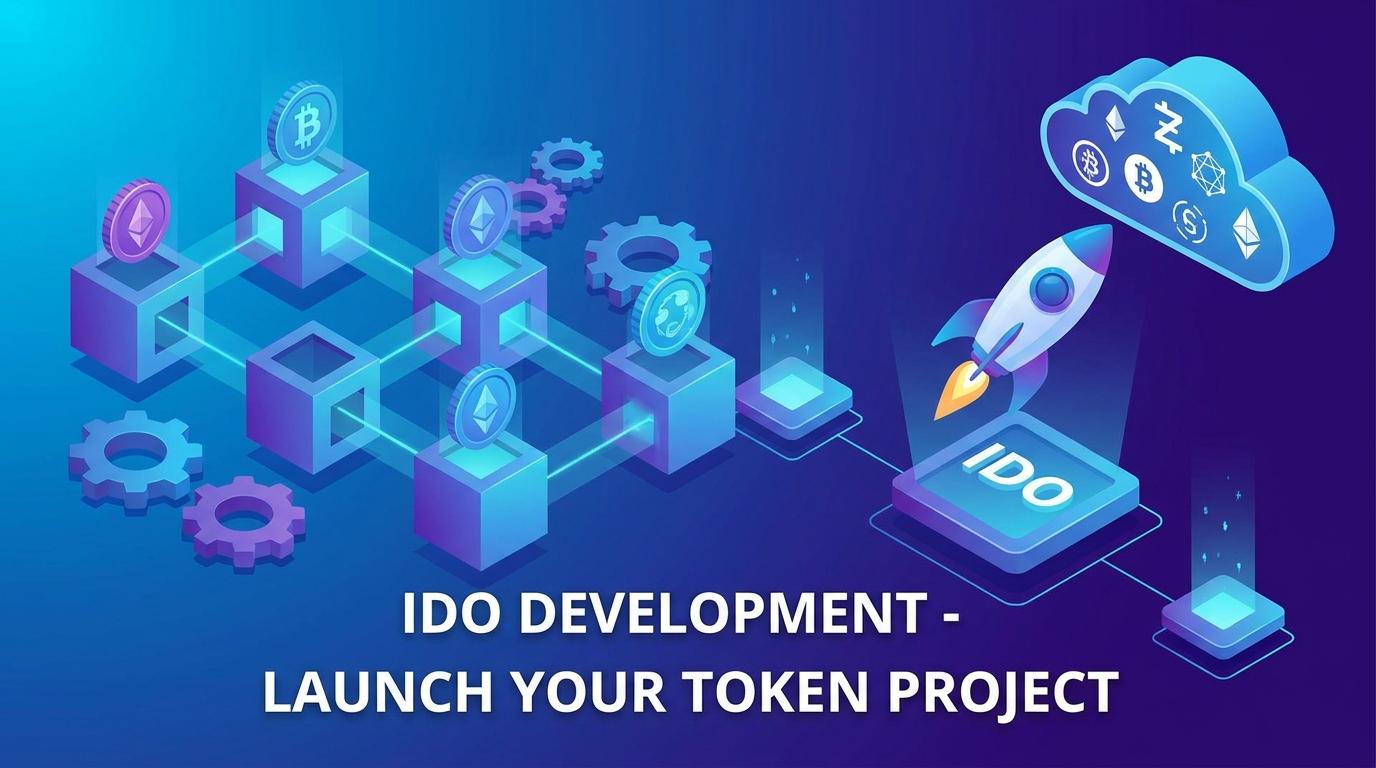
Initial DEX Offering, widely known as IDO, has become one of the most important fundraising models in the blockchain economy. Unlike traditional venture capital rounds, ICOs, or centralized exchange launches, an IDO allows a crypto project to raise capital and distribute tokens through a decentralized exchange or a DEX-connected launchpad. CoinMarketCap defines an IDO as the launch of a cryptocurrency on a decentralized exchange, where the token makes its public debut and becomes tradable for retail investors. This model gained relevance because it combines fundraising, community participation, and immediate liquidity in a single on-chain process.
IDO development refers to the complete technical, strategic, and operational process of creating this fundraising infrastructure. It includes token creation, smart contract development, launchpad integration, liquidity pool setup, vesting mechanisms, wallet connectivity, whitelist management, KYC integration where required, investor dashboards, admin panels, and post-launch liquidity planning. In a market where DeFi platforms are tracked across thousands of protocols and hundreds of chains, IDO development is no longer a simple token-sale setup; it is a full-scale blockchain product engineering discipline. DefiLlama, for example, tracks TVL, revenue, fees, volume, and yield data across more than 7,000 DeFi protocols on over 500 chains, showing how wide and competitive the decentralized finance ecosystem has become.
Why Smart Contract Security Is the Core of IDO Development
The second and most vital segment of IDO development is smart contract security, because every token sale depends on code that automatically manages investor funds, token allocation, claim rules, liquidity locks, and vesting schedules. A poorly written IDO contract can create severe risks: funds may be locked permanently, investors may receive incorrect allocations, bots may exploit the sale, or malicious actors may manipulate token distribution. This is why projects must work with a reliable Smart Contract Audit Company before opening their token sale to the public.
Professional Smart Contract Audit Services examine the token contract, sale contract, vesting contract, liquidity-locking mechanism, and any connected governance or staking modules. These audits usually include manual code review, automated vulnerability scanning, business logic analysis, gas optimization checks, privilege review, and test-case validation. Strong Smart Contract Auditing Services do not only search for obvious coding errors; they also examine whether the contract logic matches the project’s whitepaper, tokenomics, and investor commitments.
The importance of this security layer is supported by real-world data. Chainalysis reported that more than $2.17 billion had been stolen from cryptocurrency services by the end of June 2025, already surpassing the total for all of 2024. Academic research on major Ethereum and EVM-related attacks between 2022 and 2025 found that losses often came from exploit chains involving not only implementation bugs, but also protocol design flaws, governance weaknesses, external dependencies, and lifecycle mismanagement. For IDO teams, the lesson is clear: security cannot be treated as a final checklist item. It must be embedded from the earliest development phase.
How an IDO Works
A typical IDO begins when a blockchain project decides to sell a portion of its token supply to early community participants. The project either builds its own IDO launchpad or partners with an existing launchpad. Binance Academy explains that in an IDO, a project provides tokens to a DEX or launchpad, and smart contracts manage the sale, including user fund commitments, allocation, distribution, and token delivery. This automation is the defining feature of the model: instead of a centralized exchange or intermediary manually managing the process, on-chain code performs the key operations.
The process usually starts with token design. The development team defines the token standard, total supply, decimal structure, minting permissions, burn functions, transfer restrictions, governance utility, and allocation categories. Then comes tokenomics planning, where the team decides how many tokens go to public sale, private sale, team, advisors, ecosystem incentives, liquidity, staking rewards, and treasury reserves. A strong IDO tokenomics model prevents immediate oversupply while ensuring enough liquidity for trading after launch.
After token design, the IDO launchpad logic is created. This includes the sale contract, whitelist contract, allocation engine, claim contract, vesting module, and liquidity-pool integration. Investors typically connect their wallets, complete eligibility steps, commit funds, and later claim tokens based on the sale rules. In many IDOs, users do not receive the entire allocation immediately. Instead, they receive a percentage at token generation event, followed by scheduled unlocks. This vesting structure helps reduce post-launch selling pressure and protects long-term token stability.
Key Components of an IDO Launchpad
An IDO launchpad must balance transparency, scalability, investor protection, and user experience. The most successful platforms do not simply host token sales; they create trust between projects and communities. Polkastarter, for example, describes itself as a platform supporting decentralized fundraising, advisory, incubation, and access to blockchain and digital-asset projects. DAO Maker, another well-known launchpad, popularized models such as Strong Holder Offerings, where participation can depend on platform token holdings and allocation systems. CoinMarketCap notes that many modern launchpads require users to lock a minimum number of platform tokens to participate in launches.
A well-developed IDO launchpad normally includes wallet integration, sale campaign creation, investor registration, tier-based participation, KYC/AML options, anti-bot controls, token claim modules, staking systems, liquidity-pool creation, vesting dashboards, referral systems, and analytics. From the admin side, the platform must allow project owners to configure sale price, hard cap, soft cap, accepted currencies, vesting rules, sale duration, whitelist rules, refund policies, and listing parameters.
The user interface matters as much as the smart contract layer. IDO investors often act quickly, especially during high-demand sales. If the interface is confusing, transactions fail, gas estimation is inaccurate, or claim buttons are not clear, even a technically sound project can lose credibility. A professional launchpad therefore needs responsive dashboards, clear countdowns, transparent allocation displays, multilingual support where necessary, and real-time status updates for wallet transactions.
IDO Development and Liquidity Planning
Liquidity is one of the strongest advantages of the IDO model. In older ICO models, investors often had to wait for a centralized exchange listing before trading their tokens. In an IDO, tokens can become tradable soon after the sale through a DEX liquidity pool. CoinMarketCap notes that IDOs can offer quick liquidity, lower listing costs, and instantaneous trading compared with some earlier fundraising models.
However, instant liquidity is not automatically healthy liquidity. If the initial pool is too small, the token may suffer from high slippage and extreme volatility. If too many tokens unlock immediately, early participants may dump tokens and damage market confidence. If liquidity is not locked, investors may fear a rug pull. Therefore, IDO development must include a carefully designed liquidity strategy.
A strong liquidity plan considers the initial token price, pool depth, expected trading volume, market-making requirements, lock duration, and post-launch incentives. Some projects pair their token with stablecoins, while others pair it with native chain assets such as ETH, BNB, SOL, or MATIC. The right choice depends on the target blockchain, investor base, and exchange strategy. Development teams may also integrate liquidity lockers and publish lock details publicly to build trust.
Tokenomics: The Economic Foundation of an IDO
Tokenomics is the difference between a short-lived hype launch and a sustainable blockchain economy. In IDO development, tokenomics should answer four essential questions: why the token exists, who needs it, how it gains utility, and how supply enters the market over time. A token that only exists for fundraising usually struggles after launch. A token connected to governance, staking, access rights, fee discounts, game mechanics, protocol revenue, or ecosystem incentives has a stronger foundation.
Good tokenomics also avoids over-concentration. If too much supply goes to insiders, public investors may lose confidence. If team tokens unlock too early, the market may assume the founders are preparing to exit. If rewards are too aggressive, inflation can weaken price stability. The best IDO models use transparent vesting schedules, reasonable public-sale allocations, long-term ecosystem reserves, and clear treasury governance.
Real-world DeFi research shows that decentralized systems involve not only smart contract risks but also governance, oracle, frontrunning, and systemic risks. This matters for IDO tokenomics because token distribution often influences governance power. A project with decentralized branding but highly concentrated voting power may face credibility issues. Therefore, token allocation should support both fundraising and long-term governance integrity.
Compliance and Investor Protection
Although IDOs are decentralized by design, they do not exist outside legal and regulatory realities. Token offerings may be reviewed differently across jurisdictions, especially if buyers expect profits from the efforts of a team or promoter. The U.S. SEC’s digital asset framework states that offers and sales of securities, including those involving digital assets, must either be registered or qualify for an exemption. For this reason, serious IDO projects often seek legal review before launch.
Compliance features vary depending on the platform and target audience. Some IDO launchpads integrate KYC verification, geo-restrictions, sanctions screening, investor eligibility checks, and AML monitoring. FATF has also issued global standards intended to prevent misuse of virtual assets for money laundering and terrorist financing. While some fully decentralized launches avoid custodial structures, projects targeting global investors must still understand how securities, consumer protection, tax, and anti-money laundering laws may apply.
Investor protection is also a product-design issue. A responsible IDO launchpad should display project information, tokenomics, vesting schedules, audit status, liquidity-lock details, risk warnings, and refund conditions. Transparency does not eliminate market risk, but it gives participants a clearer basis for decision-making.
Real-World Examples and Market Evolution
The evolution from ICOs to IDOs reflects the crypto industry’s search for fairer, faster, and more transparent fundraising. ICOs gave early blockchain teams a way to raise capital globally, but many lacked accountability, liquidity, or investor protection. IEOs shifted fundraising to centralized exchanges, improving visibility and trust but reintroducing gatekeepers. IDOs moved the process back on-chain, enabling faster settlement, open participation, and immediate DEX liquidity.
Launchpads such as Polkastarter and DAO Maker helped formalize this model by adding curation, tier systems, whitelisting, staking, and community-building tools. Binance Academy describes Polkastarter as an IDO launchpad for decentralized and multi-chain token pools that helps startups raise capital through fixed-swap pools. These platforms demonstrate that IDO success depends on more than code. It depends on community trust, fair allocation, liquidity quality, marketing strength, and post-launch execution.
Modern IDO development is also becoming more multi-chain. Projects now launch across Ethereum, BNB Chain, Polygon, Arbitrum, Base, Solana, Avalanche, and other networks depending on fees, speed, liquidity, ecosystem fit, and target users. Cross-chain launchpads are increasingly important because investors no longer operate within one blockchain ecosystem. A competitive IDO platform should therefore support multi-chain deployment, bridge compatibility, modular contract architecture, and flexible wallet integrations.
The Future of IDO Development
The next phase of IDO development will likely be more security-driven, compliance-aware, and utility-focused. The market has matured beyond simple token launches. Investors now expect audits, transparent vesting, locked liquidity, clear roadmap execution, public team communication, and real product traction. Launchpads that cannot filter weak projects or protect users from poor token design will struggle to maintain trust.
Artificial intelligence may also influence IDO development through automated smart contract testing, investor behavior analytics, fraud detection, and launch optimization. At the same time, stronger on-chain reputation systems may reduce bot participation and reward genuine community members. More launchpads may adopt dynamic allocation systems based on user loyalty, governance participation, staking duration, or ecosystem contribution rather than simple first-come-first-served participation.
In the long run, IDOs will remain relevant because they align with the core philosophy of Web3: open access, programmable finance, and community ownership. But the winning projects will be those that treat IDO development not merely as a fundraising event, but as the foundation for a durable token economy.
Conclusion
IDO development is a powerful pathway for blockchain startups that want to raise funds, distribute tokens, build communities, and create immediate market liquidity through decentralized infrastructure. Yet success requires much more than launching a token on a DEX. It demands secure smart contracts, credible audits, sustainable tokenomics, legal awareness, liquidity planning, strong launchpad architecture, and long-term community trust. For businesses planning to enter this space with confidence, Blockchain App Factory provides best services by offering end-to-end IDO development solutions that help projects move from concept to secure, scalable, and market-ready token launches.


 English
 Arabic
 French
 Spanish
 Portuguese
 Deutsch
 Turkish
 Dutch
Dutch
 Italiano
 Russian
 Romaian
 Greek
Greek