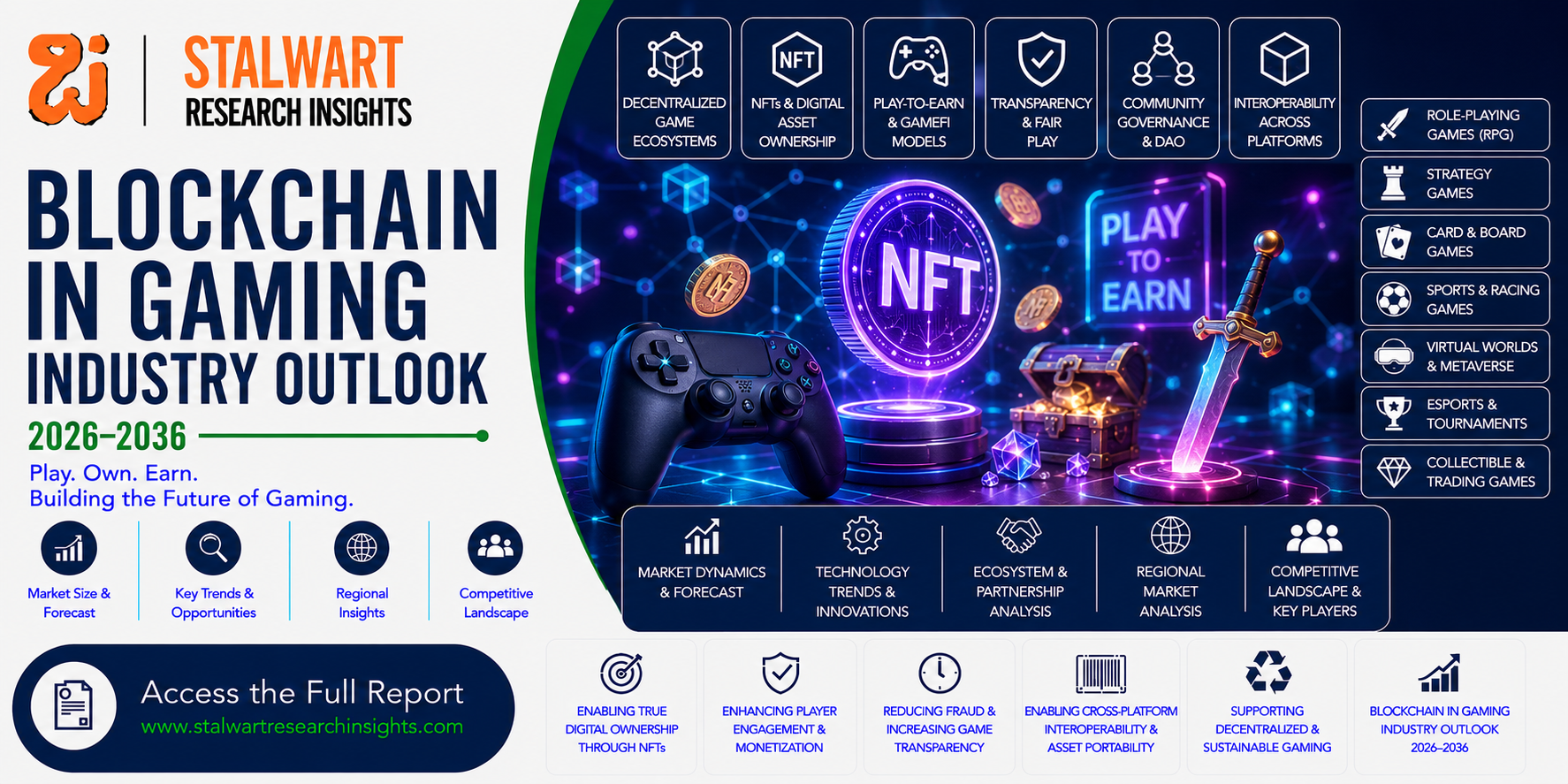
Blockchain in Gaming Industry Outlook, Market Size, Share, Trends and Forecast 2026–2036

Overview of the Market:
The Blockchain in Gaming Market is driven by increasing demand for decentralized gaming ecosystems and greater player control over digital assets. Blockchain technology enables secure ownership, trading, and transfer of in-game assets while supporting smart contracts and token-based economies. The expansion of play-to-earn models, metaverse experiences, interoperable assets, and scalable blockchain infrastructure is expected to influence the future development of the industry.
The Blockchain in Gaming Industry is transforming digital entertainment by enabling secure digital asset ownership, decentralized transactions, tokenized in-game economies, and transparent gaming ecosystems. Growing interest in Web3 gaming, NFTs, player ownership, and decentralized platforms is supporting industry development.
Industry Insights: Scale, Segments, and Shifts
Market Size & Growth: The global Blockchain in Gaming market is projected to reach USD 6724.0 billion by 2036, registering a CAGR of 68.17% between 2026 and 2036
Access the Full Report PDF Here:
Key Market Trends:
- Growing adoption of play-to-earn and player-driven gaming models.
- Increasing integration of NFTs and tokenized digital assets.
- Expansion of decentralized gaming platforms and Web3 ecosystems.
- Rising development of metaverse-based gaming experiences.
- Growing demand for cross-platform and interoperable digital assets.
- Adoption of Layer-2 and other scaling technologies to improve transaction efficiency.
- Increasing focus on blockchain-based security and transparent in-game economies.
- Growing collaboration between blockchain developers, gaming studios, and digital entertainment platforms.
Analytical Tool:
- Porter’s Five Forces Analysis
- SWOT Analysis
- PESTEL Analysis
- Value Chain Analysis
- Market Attractiveness Analysis
- Competitive Landscape Analysis
- Market Segmentation Analysis
- Regional Analysis
Regional Analysis:
- North America: Strong blockchain infrastructure, high gaming adoption, and significant investment in Web3 and digital entertainment technologies support market development.
- Europe: Growing interest in blockchain innovation, digital assets, and decentralized gaming platforms is creating opportunities across the region.
- Asia Pacific: A large gaming population, strong mobile gaming adoption, and expanding blockchain ecosystems support significant growth opportunities.
- Middle East & Africa: Emerging blockchain hubs and increasing investment in digital innovation are supporting the development of new gaming ecosystems.
- South America: Growing cryptocurrency awareness and mobile gaming adoption are creating opportunities for blockchain-based gaming platforms.
SWOT Analysis:
Strengths:
Blockchain technology enables transparent transactions, verifiable digital ownership, decentralized economies, and new monetization opportunities for gaming ecosystems.
Weaknesses:
Complex user experiences, scalability limitations, transaction costs, and limited awareness among mainstream gamers can restrict adoption.
Opportunities:
Growth opportunities include interoperable gaming assets, decentralized esports, metaverse ecosystems, tokenized economies, and collaboration with major gaming studios.
Threats:
Regulatory uncertainty, cybersecurity risks, volatile digital asset markets, consumer trust concerns, and competition from traditional gaming platforms may affect industry growth.
PESTEL Analysis:
Political:
Government policies related to digital assets, blockchain technology, and online gaming can influence market development.
Economic:
Tokenized economies and new digital monetization models can create additional revenue opportunities for developers and gaming platforms.
Social:
Increasing interest in player ownership, digital communities, online entertainment, and interactive virtual experiences supports market expansion.
Technological:
Advancements in blockchain scalability, smart contracts, NFTs, decentralized infrastructure, and cross-chain technologies are transforming gaming ecosystems.
Environmental:
The energy efficiency of blockchain networks and the adoption of more sustainable infrastructure are becoming increasingly important considerations.
Legal:
Regulations related to digital assets, intellectual property, consumer protection, data privacy, and online gaming influence industry operations.
Market Share:
By Game Type:
- Role-Playing Games
- Multiplayer Games
- Open-World Games
- Collectible Games
- Strategy Games
- Other Game Types
By Platform:
- Web-Based Gaming
- Android
- iOS
- PC Gaming
- Console Gaming
By Technology:
- NFTs
- Smart Contracts
- Cryptocurrency-Based Gaming
- Decentralized Gaming Platforms
- Other Blockchain Technologies
By Application:
- Play-to-Earn Gaming
- In-Game Asset Trading
- Digital Collectibles
- Metaverse Gaming
- Decentralized Gaming Economies
- Other Applications
Key Players:
- Animoca Brands Corporation Limited
- Autonomous Worlds Ltd.
- Dapper Labs, Inc.
- Illuvium
- Immutable
- Mythical Inc.
- ROKO GAME STUDIOS
- Sky Mavis
- Splinterlands
- Uplandme, Inc.
Challenges:
The Blockchain in Gaming Industry faces challenges related to regulatory uncertainty, blockchain scalability, transaction costs, cybersecurity risks, consumer awareness, and integration complexity. Building seamless gaming experiences while managing digital asset security and maintaining player trust remains an important challenge for industry participants.
Future Opportunities:
Future opportunities include the development of interoperable gaming assets, decentralized esports ecosystems, tokenized in-game economies, metaverse gaming environments, and partnerships between blockchain companies and established gaming studios. Improvements in scalable infrastructure and user-friendly blockchain integration could further support mainstream adoption.
Browse Trending Report:
- 3D Bio-Printed Human Tissue Market Outlook 2026–2036
- 3D Glasses Market Outlook 2026–2036
- Autonomous Surgical Systems Market Outlook 2026–2036
- AI in Automotive Market Outlook 2026–2036
- Aerospace Materials Market Outlook 2026–2036
Conclusion:
The Blockchain in Gaming Industry is expected to continue evolving as demand for digital asset ownership, decentralized economies, and immersive online gaming experiences increases. Continued innovation in scalable blockchain infrastructure, interoperability, security, and user-friendly gaming platforms is expected to create significant opportunities for industry participants.
Contact Us:
Stalwart Research Insights
Website: https://www.stalwartresearchinsights.com