


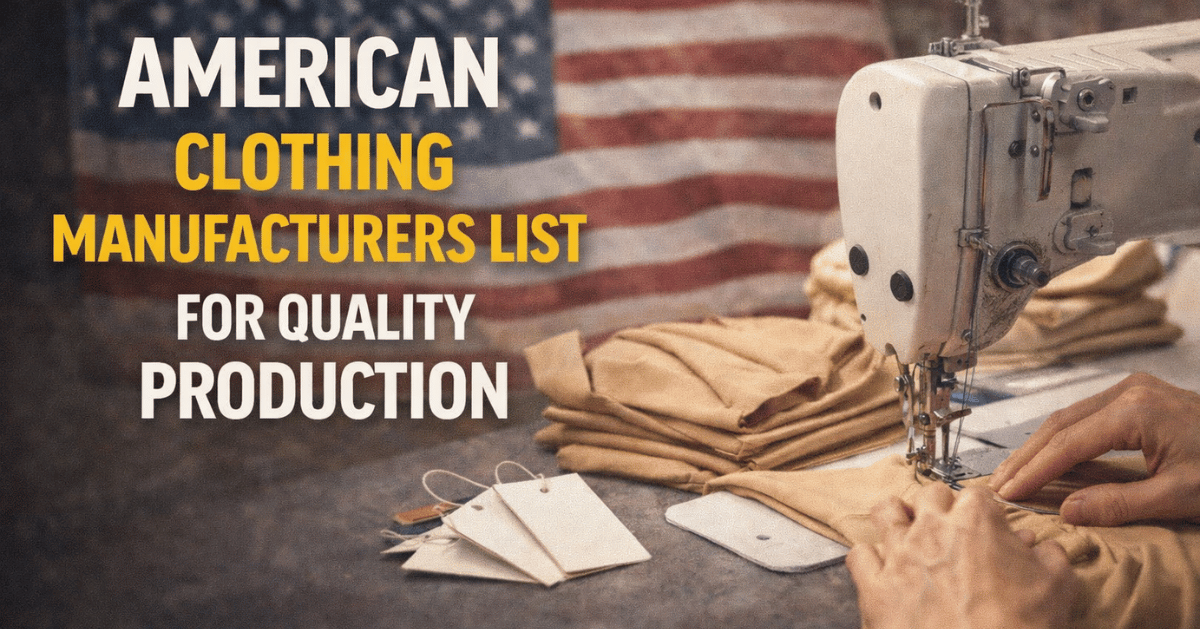
American Clothing Manufacturers List for Quality Production
Finding a quality American clothing manufacturer is one of the most valuable sourcing decisions a brand can make, and one of the most opaque searches to execute well. The information that matters most isn't on supplier websites. It's in the conversations between brands who've already done the work: who held quality across multiple seasons, who communicated honestly when a timeline shifted, who got better with every order rather than requiring the same re-qualification each time.
This guide is built around that practical knowledge. Not a directory of every factory registered in the United States, but a genuine sourcing framework, which regions have the manufacturing infrastructure worth investigating, which production categories domestic manufacturers serve best, what to look for when you find a candidate, and where Rays Creations fits in the picture for brands building across apparel and leather goods.
Why American Clothing Manufacturers Are Worth Searching For in 2026
The case for domestic apparel production has strengthened considerably in recent years and the reasons are now more practical than philosophical. Brands that chose american clothing manufacturers for quality control reasons in 2022 are reporting real operational advantages in 2026 that go well beyond the "made in USA" label.
Lead time reliability is the most consistently cited advantage. A domestic manufacturing partner operating on the same timezone and within shipping distance produces a different kind of production oversight than an overseas relationship managed through email across a twelve-hour time difference. Questions get answered the day they're asked. Samples arrive in days rather than weeks. Mid-production corrections happen when they can still be addressed rather than when they've already been replicated across hundreds of units.
Quality control access is the second operational advantage that's difficult to replicate through overseas sourcing. The brand that can visit its manufacturing partner on a Tuesday afternoon and walk the production floor has a different quality relationship than one relying on third-party inspection services and photo documentation. That visit-level access changes the quality conversation from reactive, managing problems after they've appeared, to proactive, catching variance before it compounds.
USA apparel factories have also closed the cost gap with overseas production more than many brands currently assume. Material cost increases, shipping volatility, and the cost of quality management overhead for overseas programs have shifted the total-cost comparison in ways that favor domestic production for more brands than the quoted per-unit price alone would suggest. Brands doing honest total-cost accounting, including quality management time, shipping cost and duration, and the cost of quality failures, are finding domestic production competitive in categories where it wasn't five years ago.
Rays Creations is a New York metro-based manufacturer producing jackets, leather goods, bags, wallets, and accessories at 2 Vanderbilt Parkway, Dix Hills, NY 11746. They're part of the domestic manufacturing infrastructure described in this guide and available for direct conversations at 516-528-5820 or care@rayscreations.co.
Regional Manufacturing Hubs: Where US Clothing Production Services Are Concentrated
US clothing production services are not evenly distributed across the country. Manufacturing capability is concentrated in specific regions with specific production specialties, and knowing which region to look in for a specific product type significantly narrows the search.
New York metro area remains one of the most capable domestic manufacturing regions for apparel and accessories. The Garment District's historical infrastructure has contracted but not disappeared, and the outer boroughs, Brooklyn in particular, and the Long Island corridor have absorbed significant production operations that couldn't sustain Manhattan real estate costs but maintained their proximity to the New York buyer market. The New York metro is strongest in leather goods, outerwear, and premium apparel, and the concentration of designer and brand offices in the city means that manufacturers here have been vetted against demanding quality standards over many decades.
Los Angeles is the other major domestic apparel manufacturing hub and has particular strength in contemporary fashion, activewear, denim, and swimwear. The concentration of production in the downtown LA Fashion District and surrounding neighborhoods in Vernon and Commerce creates a density of manufacturers and suppliers that makes in-person sourcing efficient. LA manufacturers have strong relationships with domestic fabric suppliers and tend to have faster sampling turnaround than most other regions for fashion-forward product.
North Carolina and the Southeast have a concentration of cut-and-sew operations with strength in basics, activewear, and workwear. The region's manufacturing tradition goes back to the domestic textile industry's historical base there, and the operations that have survived and invested have done so by building quality and efficiency advantages that complement rather than compete with fashion-forward LA and NY manufacturers. The Southeast is where brands building basics programs, athletic programs, and workwear lines often find their most cost-efficient domestic production.
Texas and the Southwest have growing apparel production capability, particularly in denim and Western-influenced styles where the regional market proximity creates category expertise. San Antonio and El Paso have significant garment manufacturing operations with established infrastructure and workforce expertise.
Pacific Northwest has a smaller but quality-focused apparel manufacturing community, with particular strength in outdoor and technical apparel, brands building in the outdoor, hiking, and technical performance space often find the most technically knowledgeable domestic partners here.
What Domestic Garment Production Companies Do Best
Domestic garment production companies have specific production advantages over overseas alternatives that are worth matching to the right product categories.
Custom and small-batch development work is where domestic manufacturers provide the most clear advantage. The iteration speed of domestic sampling, a revised spec responded to in days, a new sample in a week, compresses the development timeline in ways that matter commercially. Brands launching products in response to market signals, building private label programs that require multiple spec iterations, or developing technical products that need hands-on refinement are well-served by domestic development capability regardless of where bulk production ultimately happens.
Premium outerwear and leather goods production is a category where domestic manufacturers, particularly in the New York metro area, maintain genuine expertise built from decades of production for demanding retail buyers. The construction knowledge for quality bomber jackets, biker jackets, varsity jackets, and leather accessories requires specific tooling, technique, and quality standards that general apparel factories don't maintain. Brands building in these categories benefit disproportionately from finding domestic specialists.
Private label apparel programs benefit from domestic production through the IP protection advantage that the US legal framework provides. A private label program's proprietary patterns, design files, and construction details are better protected by domestic production than by overseas manufacturing, particularly for brands in the growth stage whose designs are commercially valuable but whose IP enforcement capacity is limited.
Ethical and transparent supply chain programs require domestic production in many cases because the supply chain transparency customers are increasingly demanding, where is this made, by whom, under what labor conditions, is most practically delivered through domestic manufacturing relationships. Ethical clothing production USA is not just a marketing position for the growing segment of customers who make purchase decisions based on it. It's a sourcing requirement, and meeting it requires genuine domestic production.
Private Label Clothing USA: What to Look for in a Manufacturing Partner
Private label clothing USA programs have specific manufacturing requirements that distinguish the right manufacturing partners from the merely adequate ones.
The spec process depth is the first evaluation criterion. A manufacturing partner who treats a private label spec as a conversation, who asks questions about the intended wearing context, the target customer's body type, the quality signals the brand's retail price needs to support, is a partner who understands that private label success depends on product specificity rather than generic production. One who treats the spec as a form to fill out is a manufacturer who will produce what's described rather than what's needed.
The sample iteration commitment is the second. Private label development almost always requires multiple sample rounds, and the value of a domestic manufacturing partner is directly proportional to the speed and specificity of their iteration response. A partner who can turn a revised sample in a week and communicate specific questions about unclear spec points is a development resource. One who takes three weeks per iteration and implements without clarifying ambiguous instructions is a production vendor, useful after development is complete, limiting during it.
The production documentation standard is the third. Made in USA clothing suppliers who produce private label programs should issue written spec sheets, maintain sample approval records, and provide mid-production quality confirmation that both parties can reference if a question arises about whether production matched the approved standard. This documentation is not bureaucratic overhead, it's the evidence record that protects both sides of the manufacturing relationship and that makes quality consistency auditable rather than asserted.
The scaling capacity is the fourth. A manufacturing partner who can handle the brand's first private label run at 100 units should also be evaluated for their capacity to handle 500 units two seasons later without quality degradation or timeline expansion. Asking directly about maximum production volume, lead time at volume, and quality control process at higher quantities during initial sourcing is the question that most brands skip and most wish they'd asked.
Bulk Apparel Producers USA: Finding Operations at Scale
Bulk apparel producers USA, manufacturing operations capable of handling genuine volume across regular production cycles, are a smaller group than the general american clothing manufacturers market suggests. Many domestic operations excel at small batches, custom development, and first-run production but don't have the production infrastructure to scale with a growing brand.
The evaluation criteria for bulk production capability:
Equipment investment. A manufacturer who's invested in industrial-grade equipment, commercial cutting machines, industrial sewing stations scaled for volume, quality inspection infrastructure, has made the capital commitment that bulk production requires. A manufacturer who handles small batches on equipment that works for their current volume but hasn't been scaled for higher capacity will struggle when volume increases, usually in ways that show up as lead time extensions and quality variance rather than as a direct capacity admission.
Production floor size and team structure. A manufacturer whose production floor has a structured workflow, clear stations for each production stage, team roles that separate quality inspection from production, has organized for volume. One whose production team handles multiple functions and whose floor is organized around flexibility rather than throughput is optimized for variety, not for the kind of focused bulk production that consistent volume programs require.
Reference accounts at volume. The most direct evidence of bulk production capability is references from brands who've been using the manufacturer at meaningful volume for multiple seasons. Ask specifically: what volumes are they currently running for comparable accounts, and what's the lead time at those volumes? A manufacturer who can answer with specific numbers and connect you to reference accounts who'll confirm them has demonstrated capacity rather than claimed it.
Local garment factories USA that serve bulk apparel programs typically develop relationships with regional suppliers, fabric houses, trim suppliers, hardware vendors, that give them supply chain depth that protects lead times. A manufacturer with established regional supplier relationships is less vulnerable to the material availability problems that can expand lead times, because they have alternatives and relationships that a manufacturer without this infrastructure doesn't.
American Fashion Manufacturers: The Custom Clothing Makers USA Worth Finding
American fashion manufacturers who build genuine expertise in specific product categories are the suppliers worth finding and investing in for the long term. The domestic manufacturing market has enough variety that the right manufacturer for a premium leather jacket is different from the right one for high-performance activewear, which is different from the right one for fashion-forward denim. Category specialization produces quality depth that general production capability doesn't.
Custom clothing makers USA who specialize in outerwear, specifically the jacket categories where construction knowledge is category-specific, have expertise that brands building outerwear programs should prioritize. The manufacturer who builds bombers, bikers, denim, and varsity jackets regularly understands the construction differences between them: why a biker jacket sleeve-to-body join requires different handling than a bomber's, what wool weight works for a varsity body in a northeastern climate, how to spec a denim jacket wash treatment for consistency across a bulk run. This knowledge is not generalized. It's built from category-specific production experience, and the brand that finds a manufacturer with it gets access to development guidance that makes every product decision more accurate.
For brands building across apparel and leather accessories, the combination of outerwear and bags, wallets, and leather goods, the manufacturer who handles both categories from one operation is particularly valuable. The quality philosophy that shapes the jacket line shapes the leather goods line. The material sourcing standard that applies to an outerwear shell applies to a bag body. The result is a product line that feels coherent because it was made coherently, by one manufacturing partner who understood both categories at a production level rather than treating one as a core specialty and the other as a catalog addition.
Rays Creations represents this multi-category manufacturing depth. Outerwear, bombers, bikers, denim, varsity, leather, windbreakers, alongside leather bags, wallets, crossbody bags, duffle bags, totes, purses, and a full apparel range including t-shirts, hoodies, and activewear. All from one manufacturing operation in the New York metro area, with one quality standard applied across every category. That range makes Rays Creations a single-source option for brands building across apparel and accessories who want the coherence and operational simplicity of one manufacturing relationship rather than the overhead and quality variance of several.
How to Evaluate Any Manufacturer on This List
Finding a manufacturer is step one. Evaluating them properly before committing is where most sourcing decisions succeed or fail, and the evaluation has specific steps that work regardless of which manufacturer is being considered.
Request production examples from bulk runs, not curated samples. The sample a manufacturer shows at a trade show or sends in response to an initial inquiry is produced under sample conditions, best hands, full attention, review before sending. Multiple units from a previous bulk run of the same or comparable style are the evidence of production quality, not the sample. Ask for three to five units from a recent production run and evaluate them for consistency across units. Variance between units reveals the range of what bulk production actually delivers.
Ask the construction questions, not the quality questions. "Do you make quality product" generates a universal affirmative that provides no information. "What boiled wool weight do you use for varsity bodies and why" generates an answer that reveals category knowledge. "How is the sleeve-to-body join reinforced on your biker jackets" reveals whether the manufacturer understands why that join is the critical construction point. The quality of answers to specific construction questions is the most reliable predictor of production quality across categories.
Visit the facility if geography allows. The New York metro area's density of manufacturer operations makes facility visits practical for brands based in or near New York in a way that overseas manufacturing doesn't permit. A thirty-minute facility visit shows things that no catalog or website communicates: the condition and scale of the equipment, the workflow organization on the production floor, the way the team talks about their own product. For domestic manufacturers, not visiting before a first order is leaving a significant evaluation tool unused.
Confirm lead times with reference accounts, not just the manufacturer's sales conversation. A manufacturer's quoted lead time is what they achieve under favorable conditions. Reference accounts who've been through multiple production cycles with the same manufacturer can tell you what actual lead times look like across a full season, including how the manufacturer handles timeline challenges when they arise and whether communication is proactive or reactive when a delay develops.
Run a first order at a conservative volume. The evaluation that a reference conversation and facility visit don't provide is the actual production experience. A first order at a volume the brand can absorb if quality doesn't match expectations is the real qualification test. It costs more per unit than a bulk commitment would, but it's the investment that makes every subsequent order genuinely informed rather than cautiously hopeful.
Rays Creations: A New York Manufacturer Worth the Conversation
Rays Creations is a manufacturing operation at 2 Vanderbilt Parkway, Dix Hills, NY 11746. Their production covers the full outerwear range, bomber jackets, biker jackets, denim jackets, varsity jackets, leather jackets, and windbreakers, alongside t-shirts, hoodies, activewear, leather bags, wallets, crossbody bags, duffle bags, totes, purses, laptop bags, gloves, belts, and keychains.
For brands evaluating american clothing manufacturers who want to work with a manufacturer that:
- Is accessible for facility visits in the New York metro area
- Produces across both outerwear and leather goods with consistent quality standards
- Offers customization depth that creates genuine product exclusivity rather than surface branding
- Has production infrastructure for bulk programs with reliable lead times
- Communicates at the manufacturer level on construction-specific questions
...the conversation starts with a direct inquiry at 516-528-5820 or care@rayscreations.co.
The Search Is Worth It. The Right Manufacturer Changes Everything.
The American clothing manufacturers worth working with are not necessarily the easiest to find. They've built their businesses through relationships and referrals more than through marketing, which means they don't always surface in the first page of search results or in the most prominent trade show booth.
Finding them takes the combination of approaches described in this guide: the regional knowledge to look in the right places, the evaluation discipline to qualify properly once a candidate is found, and the sourcing patience to prioritize the long-term manufacturing relationship over the short-term convenience of the closest available quote.
The investment is worthwhile. A domestic manufacturing partner who understands the product, holds quality across production cycles, and communicates honestly when challenges arise is one of the most durable competitive advantages available to an apparel and accessories brand. That partner exists. They're worth finding. And once found, they're worth building with.

 English
 Arabic
 Spanish
 Portuguese
 Deutsch
 Turkish
 Dutch
Dutch
 Italiano
 Russian
 Romaian
 Portuguese (Brazil)
 Greek
Greek